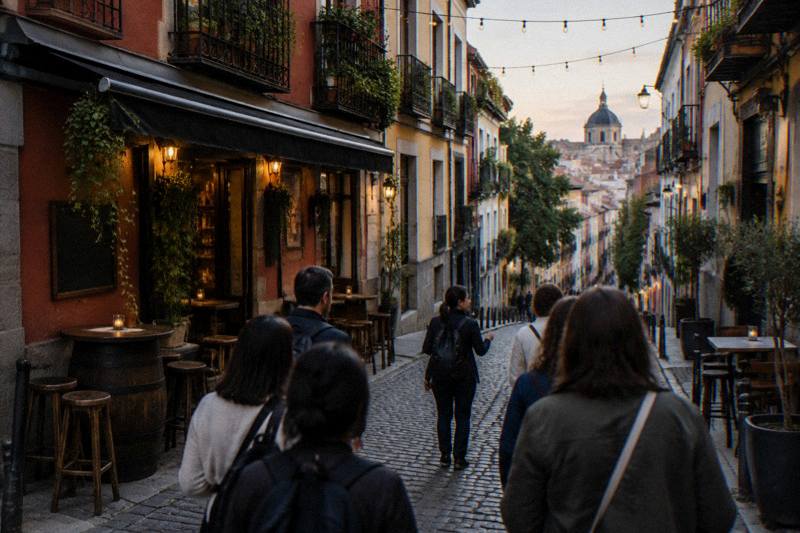
Madrid On A Budget: What A Day Actually Costs And How To Spend Almost Nothing
Madrid rewards travellers who plan around its free windows instead of paying full price for everything. Here is what a day actually costs, where the genuine free entry sits, and which pay-what-you-want walks give the most back for the least outlay.
Short answer
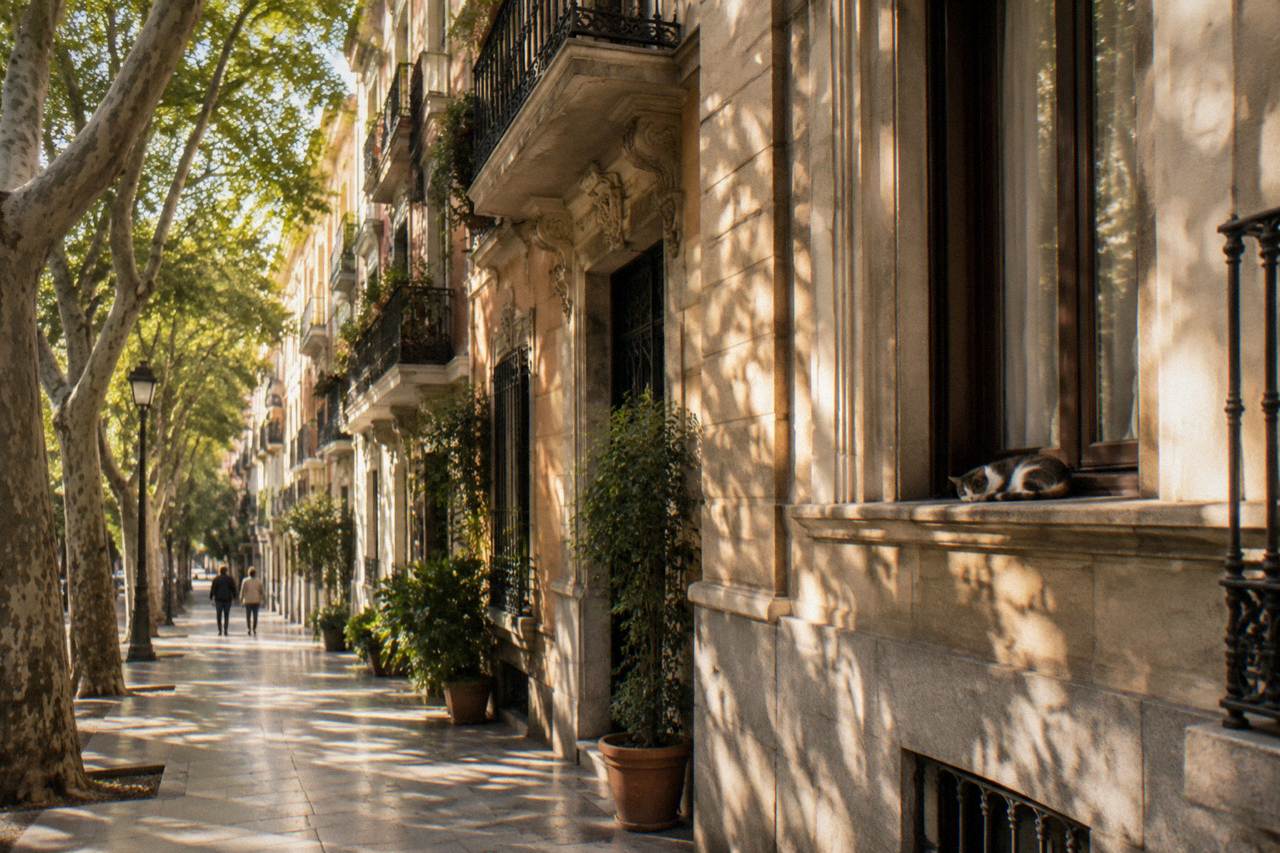
A budget day in Madrid can run on roughly EUR 20-30 per person: a EUR 1.60 single metro ride or a walkable centre, a EUR 3-4 menú del día lunch, free-entry museum windows in the evening, and pay-what-you-want walking tours that cost whatever you decide to tip. The expensive version of Madrid is entirely optional.
How Expensive Is Madrid, Really?
Madrid is one of Western Europe's more forgiving capitals for budget travellers. The historic centre is compact enough to walk end to end, the flagship museums open their permanent collections free for two hours every day, and pay-what-you-want walking tours mean a guided morning costs whatever you decide it was worth. A disciplined traveller can hold a full day to roughly EUR 20-30 without feeling deprived. The expensive version of Madrid is entirely opt-in.
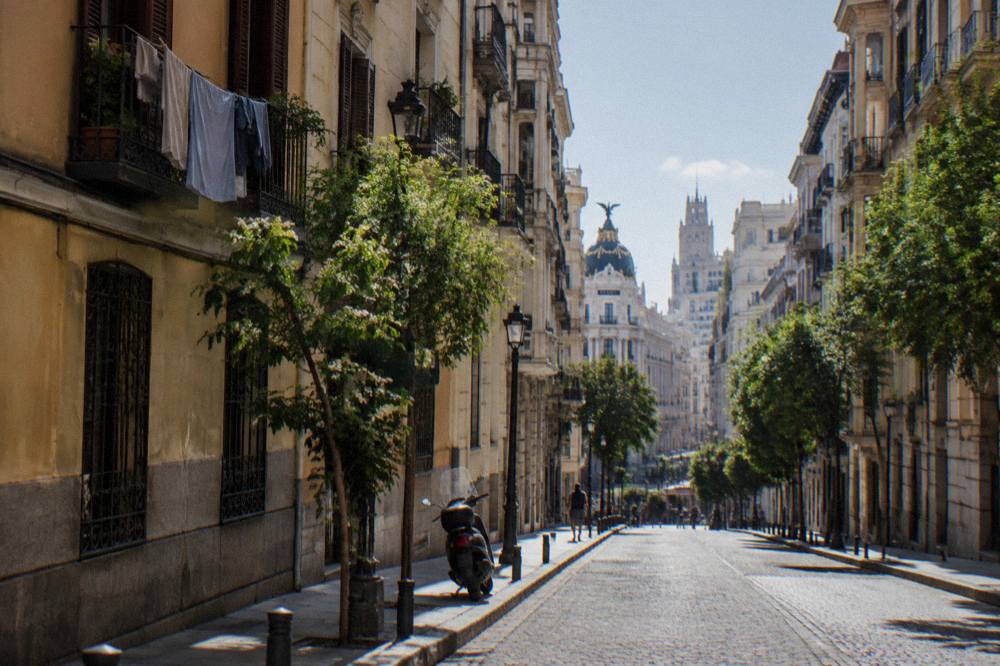
The single biggest budget lever is geography. Puerta del Sol, Plaza Mayor, the Royal Palace, the La Latina tapas quarter and Parque del Retiro all sit within a 30 minute walk of one another. A visitor who bases themselves anywhere inside the M-30 ring road can genuinely skip transit for days at a time, and the metro's flat single fare means the occasional ride is a rounding error rather than a line item.
The second lever is timing. Madrid's state museums concentrate their free windows in the evening, the municipal museums are free all day with no conditions at all, and the city's two biggest green spaces, Retiro and Madrid Río, cost nothing by design. Stack those against a paid-ticket itinerary and the maths changes fast: a family of four that hits the free Prado window instead of buying four timed tickets saves the price of a full dinner.
This guide walks through the real numbers, transit, food, museums, and the free-walk scene, and ends with a sample day that spends almost nothing. If you want the deeper version of any single topic, the pieces on budget museums in Madrid and the Prado's free hours go further than this overview can.
Can A Free Walking Tour Really Anchor A Budget Day?
Yes, and it may be the highest-value line item in any Madrid budget. Pay-what-you-want walks cost nothing to join: you reserve a place, walk two to three hours with a local guide, and pay only what you choose at the end. The Original Free Tour of Madrid, listed on freetour.com, is rated 9.3 out of 10 across 21,435 reviews, runs 2 hours 30 minutes in English and Spanish, and has no minimum tip.
The mechanics matter for budgeting because the cost is entirely under your control. A typical tip runs a few euros per person for a standard walk, more if the guide was exceptional, and nothing at all is legally required. That makes the walking tour the rare travel product where the price is set after you have consumed it, which is why budget guides keep recommending them and why the good ones fill up.
The platform split is worth knowing. Most of Madrid's walks run on GuruWalk, a directory of independent local guides; a handful, including The Original Free Tour, run on freetour.com. Both work the same way at street level: book online, show up at the meeting point, pay what you want at the end. Our guide to GuruWalk in Madrid explains the model in detail, and the question "is GuruWalk legit" comes up often enough that we answered it directly.
For a budget day, three walks stand out. The Original Free Tour covers the classic centre from Plaza Mayor, meeting in front of the Tourist Information Centre. The Retiro And Gran Vía Route, a GuruWalk walk rated 4.98 out of 5 across 1,249 reviews, takes in the park and the avenue over 2 hours 30 minutes and meets at Puerta del Sol. The Millennium Austrias Walk, rated 4.51 out of 5 across 763 reviews, works the oldest streets of the city in the same timeframe. All three are English-language capable, and all three cost what you decide.
If you only book one thing before you fly, make it one of these. A reservation costs nothing, the cancellation is free, and a good first-morning walk saves money for the rest of the trip by telling you which neighbourhoods are worth your time and which paid attractions are skippable.
The Original Free Tour deserves its own paragraph because it is the walk most budget itineraries are quietly built around. It starts at Plaza Mayor, the exact square where a cheap day tends to begin anyway, and its 2 hours 30 minutes line up neatly with a morning before the museums open. Reserve a place through the freetour.com listing and tip what the morning was worth to you.
Museum Free Windows Versus Paid Tickets: Where The Real Savings Are
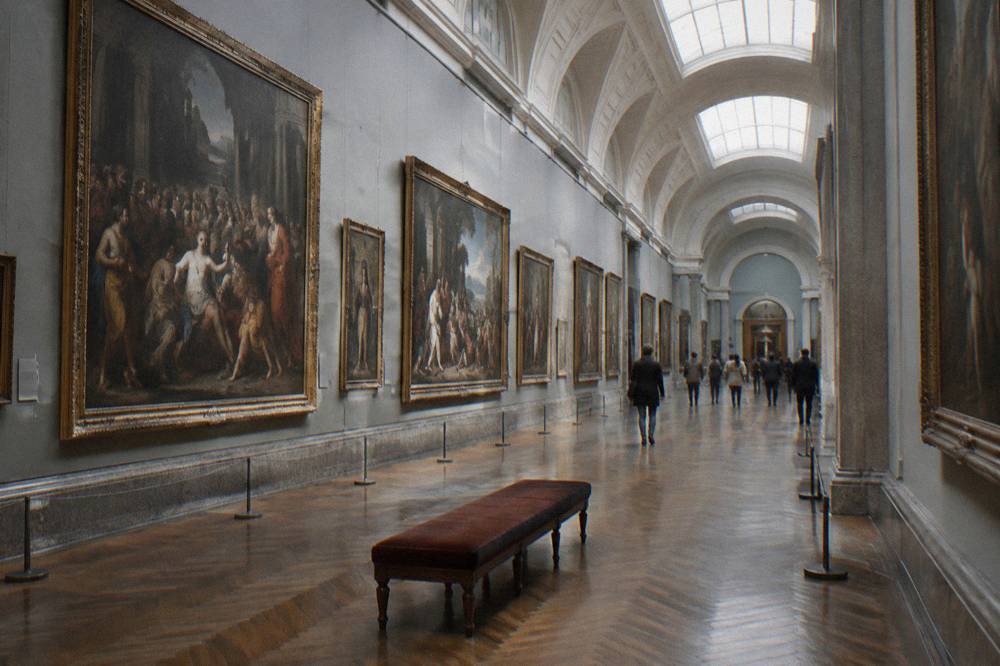
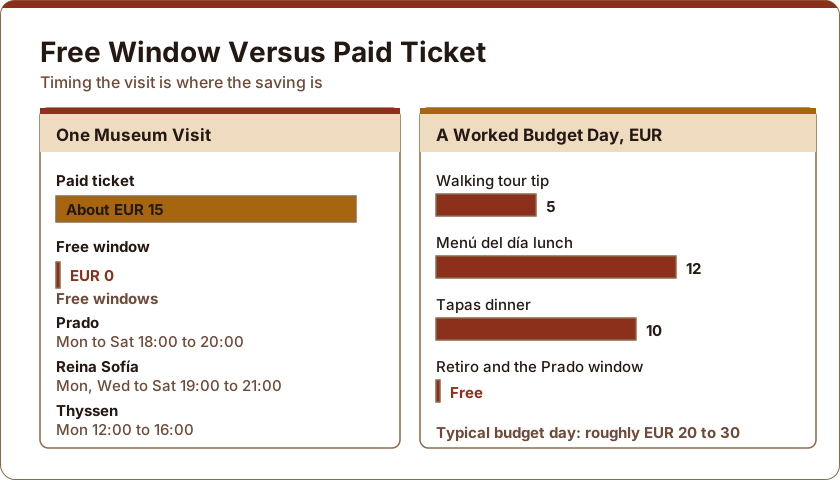
In Madrid, the real savings come from timing rather than ticket type: the Prado is free for its last two hours every day (18:00 to 20:00 Monday to Saturday, 17:00 to 19:00 on Sundays and holidays), and Reina Sofía runs free evening slots Monday and Wednesday to Saturday from 19:00 to 21:00, plus 12:30 to 14:30 on Sundays. Paying full price usually just means arriving at the wrong hour.
The state and municipal networks must not be confused, because their rules are opposite in shape. State museums, the Prado, Reina Sofía, Thyssen, Romanticismo, Cerralbo, Arqueológico Nacional, Traje, each have their own specific free window, and none of them are identical. The Thyssen, for example, is free Monday 12:00-16:00 for the permanent collection, with a separate late Saturday slot covering only temporary exhibitions. Cerralbo adds a Thursday 17:00-20:00 window on top of its weekend hours. The municipal network, by contrast, charges nothing at all, ever: no windows, no booking, no small print.
Two cautions from the current season. The Palacio de Cristal in Retiro, normally free, is closed for a roughly EUR 7.5 million glass-and-iron renovation and should reopen around July 2027, so do not budget a visit around it. The Museo Sorolla's historic house remains closed; only its new extension, entered from Zurbano 68, opens to the public on 15 October 2026. The full rundown of free museums keeps both statuses current.
| Museum | Free window | Notes for budget planning |
|---|---|---|
| Museo del Prado | Mon-Sat 18:00-20:00, Sun/holidays 17:00-19:00 | Collection only, capacity-limited, walk-up ticket required |
| Reina Sofía | Mon, Wed-Sat 19:00-21:00, Sun 12:30-14:30 | Individuals only; closed Tuesdays; bonus free dates include 18 April, 18 May, 12 October, 6 December |
| Thyssen-Bornemisza | Mon 12:00-16:00 | Permanent collection only; separate Sat 21:00-23:00 slot for temporary shows |
| Cerralbo / Romanticismo / Arqueológico Nacional | Sat from 14:00 + all day Sunday | Plus the four fixed bonus dates; Cerralbo adds Thu 17:00-20:00 |
| San Isidro / Historia de Madrid | Free all day, year-round | Municipal network, no conditions |
The trade-off is honest: the free windows are crowded, you get two hours rather than a whole afternoon, and you cannot dawdle. But for a budget traveller two hours in the Prado is plenty, and the EUR 15 or so saved per person is a full day of food. The Prado free hours guide and the Reina Sofía free entry guide cover the tactics, queueing and route order, in depth.
One palace deserves special mention because the rule is unusual. The Royal Palace offers free entry in a window reserved for EU and Latin American residents, ticket-office only, self-guided and capacity-limited, which is a different mechanism from the museums. The Royal Palace free entry guide explains who qualifies and how the queue works, and the question "is the Royal Palace in Madrid free" answers it in short form.
What Does Getting Around Madrid Cost?
Almost nothing if you stay central. The historic core is walkable, and the metro's flat single fare of about EUR 1.60 makes any one ride trivial. A 10-journey ticket brings the per-ride price down further, and the airport connection is a single fare rather than a premium price. A visitor sleeping inside the centre can realistically budget EUR 3-5 per day for transport, or EUR 0 on walkable days.
The walkability is the headline. Kilometre Zero at Puerta del Sol is the symbolic centre of Spain, and from that stone, Plaza Mayor is four minutes away on foot, the Royal Palace ten, El Rastro fifteen on a Sunday, and Retiro twenty-five. The Old Town Walk, Five Languages, a GuruWalk walk rated 4.92 out of 5 across 10,008 reviews, covers exactly this compact territory in 2 hours 15 minutes, which tells you how small the essential centre really is. It meets at Kilometre Zero itself, under the Tio Pepe sign, and runs in English, Spanish, French, Italian and Portuguese.
Buses and the metro use the same fare structure, so the choice between them is about speed, not money. The overground views from a bus along Gran Vía are free entertainment in their own right. Taxis and rideshares are the one transport line that can wreck a budget day, because short hops across the centre cost more than the entire day's food budget; a 15 minute walk replaces almost all of them.
The airport transfer is the one unavoidable ride. The metro reaches the city centre for a standard fare with one change, in roughly 45 minutes, versus a flat-fee taxi at several times the price. For a budget arrival, the metro wins unless you land at 3am with heavy luggage.
How Cheap Can Eating In Madrid Actually Be?
Very, if you eat where Madrileños eat. A menú del día, the fixed weekday lunch, typically runs EUR 12-15 in the centre and less in residential neighbourhoods, and includes two courses, bread and a drink. A tapas crawl in La Latina or Lavapiés can hold dinner to EUR 8-12 per person with a drink in hand. The trap is the tourist strip around Plaza Mayor, where the same food costs double.
The market halls are a budget traveller's secret weapon. Mercado de San Miguel, the glass hall beside Plaza Mayor, is beautiful but priced for tourists, and browsing is free even if buying is not; the question of whether San Miguel is free is really a question about what you buy there. The neighbourhood markets, Mercado de Antón Martín, Vallehermoso, the ones without a postcard reputation, sell vermouth and croquetas at local prices.
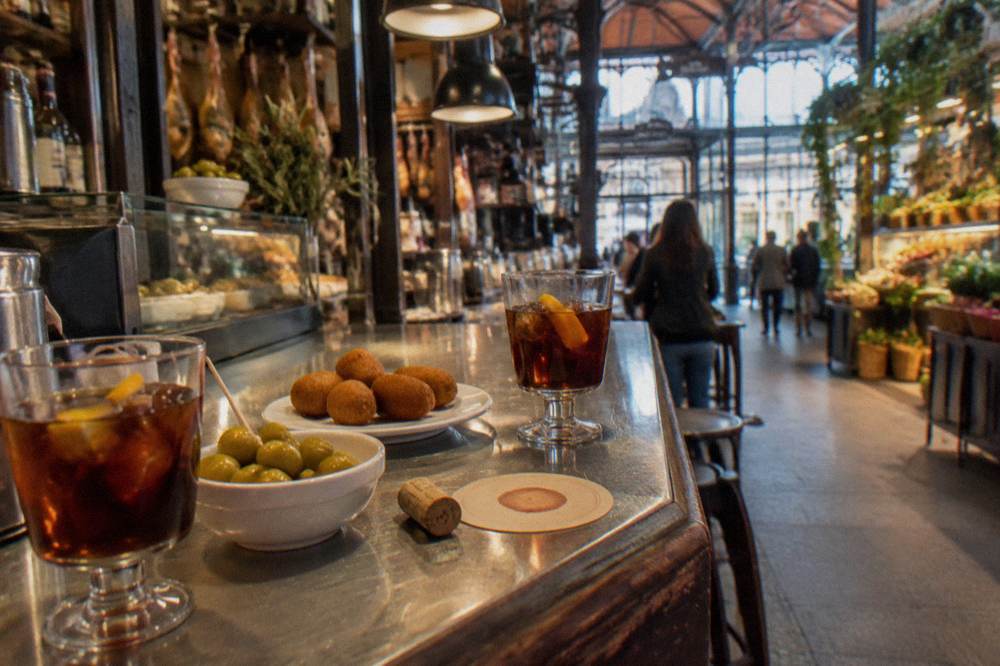
Breakfast is the cheapest meal of the day by tradition: a café con leche and a churros order runs a couple of euros at a standing bar, and standing is itself the discount, since table service adds a small premium. Lunch, eaten at the Spanish hour of 14:00 or later, is the meal to spend money on, because the menú del día is the best value-to-quantity ratio in the city. Dinner can then be tapas, which in the right bars arrive free with each drink, though that custom has thinned and should be treated as a bonus rather than a plan. Everything else covered here is indexed on Free Things To Do In Madrid.
| Meal strategy | Typical cost per person | Where it works best |
|---|---|---|
| Standing bar breakfast | EUR 2-4 | Any neighbourhood bar before 10:00 |
| Menú del día lunch | EUR 12-15 centre, EUR 10-13 residential | Everywhere on weekdays |
| Tapas dinner with drinks | EUR 8-12 | La Latina, Lavapiés, Malasaña |
| Tourist-strip dinner | EUR 25-40 | Plaza Mayor arcades, avoidable |
For the food-focused version of the free-walk idea, the Tapas And Markets Walk, a GuruWalk walk rated 4.75 out of 5 across 137 reviews, spends 2 hours 45 minutes on exactly this territory in English, Spanish and Italian, meeting under the statue of Philip III at Plaza Mayor. It is the one walk that doubles as a scouting trip for where to eat cheaply afterwards.
What Are The Best Free Things To Do Between Meals?
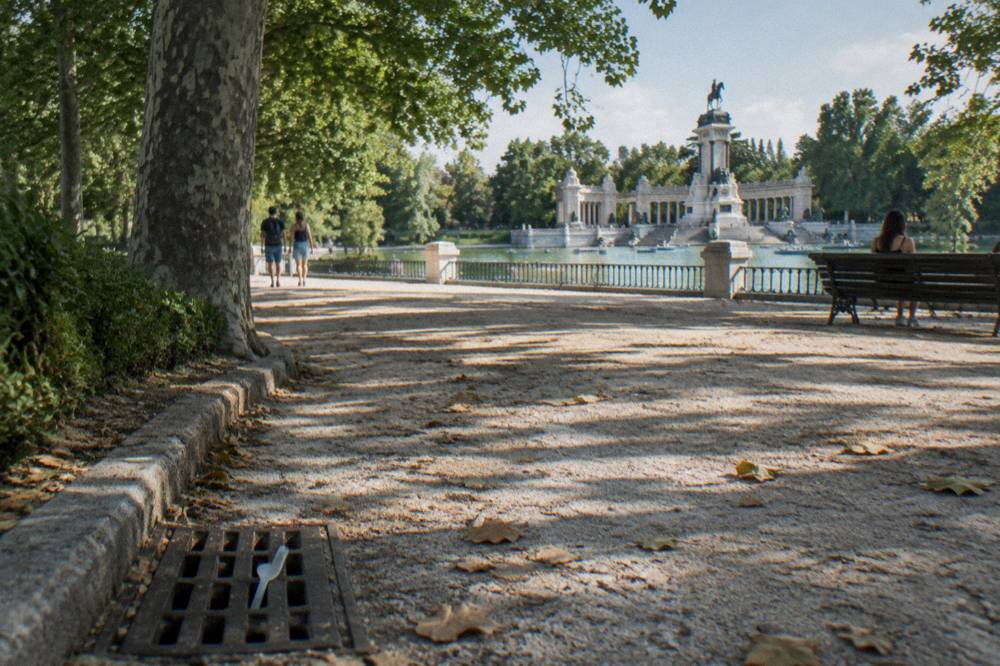
Parks, plazas and viewpoints, all of them free by design. Parque del Retiro costs nothing, from the Rosaleda rose garden to the lawns; Madrid Río is a free linear park along the river; the Templo de Debod's exterior and its sunset viewpoint are always free, with only the temple interior requiring a free advance booking. Add the always-open plazas and the free-entry cathedrals, and the between-meals hours fill themselves without a ticket.
Retiro is the anchor. It is large enough to absorb half a day, and its free status is unconditional, as the Retiro Park guide details. The Palacio de Velázquez inside it reopened on 24 June 2026 after rehabilitation and is a free exhibition space now, a genuinely fresh fact that most guidebooks have not caught up with. The Palacio de Cristal next door, as noted above, is closed until roughly July 2027.
The palace district is the other free cluster. The Jardines de Sabatini, the formal gardens beside the Royal Palace, are free, as is Campo del Moro below them. The Almudena Cathedral's nave and crypt are both free to enter, the crypt with an optional EUR 1 donation, though the cathedral museum is separately ticketed; the Almudena entry question is answered in full elsewhere on this site. The Royal Palace And Theatre Walk, a GuruWalk walk rated 4.89 out of 5 across 1,976 reviews, threads this exact district in 2 hours 30 minutes, meeting at the bear statue in Puerta del Sol, and it pairs naturally with a free-garden afternoon.
Sunset is a budget event in itself. The Templo de Debod viewpoint, free and always open, is the classic one, and the Templo de Debod guide covers the interior booking rule, free but reservation-gated, that catches out visitors who assume the whole site is walk-in. A picnic dinner bought at a market, eaten on the Debod lawn while the sky goes orange, is the single best value-to-memory ratio in the city.
| Free activity | Cost | Best time of day |
|---|---|---|
| Parque del Retiro, including Rosaleda | Free | Morning |
| Jardines de Sabatini and Campo del Moro | Free | Midday |
| Almudena Cathedral nave and crypt | Free, optional EUR 1 crypt donation | Any daylight hour |
| Templo de Debod viewpoint | Free | Sunset |
| El Rastro market browsing | Free to browse | Sunday mornings |
| Palacio de Velázquez exhibitions | Free | Afternoons, closed Mondays typical |
How Do The Walks Compare When The Budget Is The Priority?
On price they are identical, because every walk on this site is pay-what-you-want, so the comparison is about fit rather than cost. The Original Free Tour, 9.3 out of 10 across 21,435 freetour.com reviews, is the biggest-review default for first-timers. The GuruWalk alternatives trade some review volume for smaller groups or shorter formats, and all of them cost whatever you tip at the end.
The choice comes down to pace and appetite. OgoTours Small-Group Essentials holds 4.93 out of 5 across 174 GuruWalk reviews, the 2-Hour Historical Center Walk holds 4.76 out of 5 across 200 reviews, and the Essentials, 2 Hours 15 walk holds 4.91 out of 5 across 164 reviews. The 2-hour options suit travellers with a museum window booked for the afternoon; the longer formats suit those who want the full centre unpacked in one go. Small-group formats suit anyone who wants to ask questions; big-review formats suit anyone who wants the reassurance of a proven product. The free walking tour overview compares the whole roster side by side.
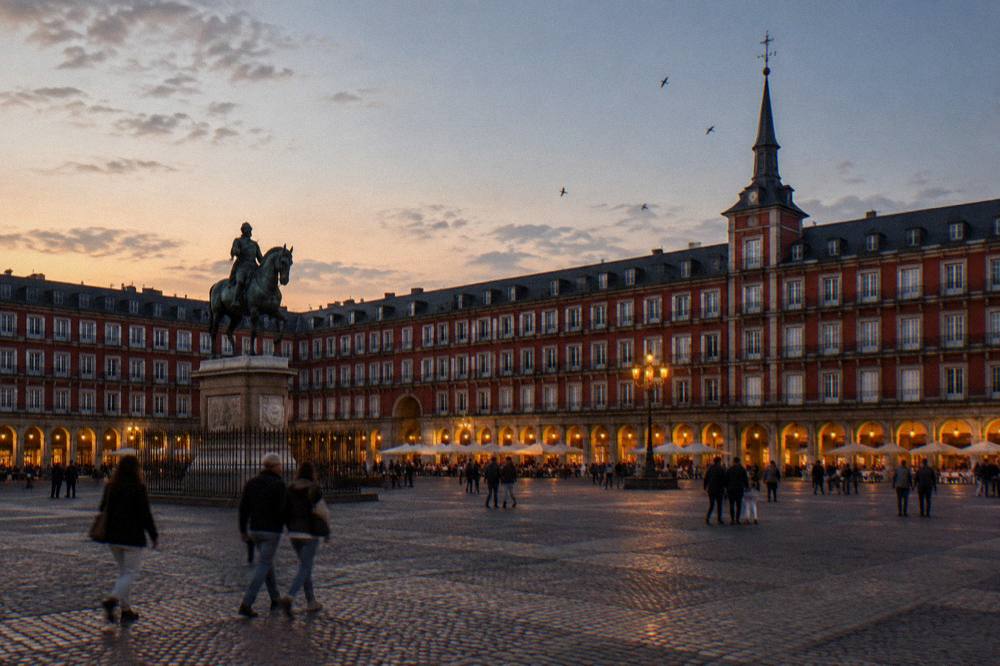
Timing matters more than selection. Morning walks end around 13:00, which lines up with the Spanish lunch hour and the menú del día prices. Evening walks, including the ghost and legends tours, pair with the free museum windows: a 19:00 Prado entry followed by a 20:30 dark-history walk is a full evening for the price of two tips. The Dark Side And Terror Walk, rated 4.9 out of 5 across 786 GuruWalk reviews, Medieval At Dusk, rated 4.97 out of 5 across 553 reviews, and the Tapas And Markets Walk, rated 4.75 out of 5 across 137 reviews, cover the after-dark and food angles respectively, and all three are pay-what-you-want like everything else on this page.
What Does A Full Budget Day In Madrid Look Like?
Here is a worked example that spends almost nothing. Morning: a free walking tour from Plaza Mayor, tip EUR 5. Lunch: a menú del día at EUR 12. Afternoon: Retiro Park and the Palacio de Velázquez, free. Evening: the Prado's free 18:00-20:00 window. Dinner: tapas in La Latina at EUR 10. Transport: none, the whole route is walkable. Total, about EUR 27 plus the tip you choose.
The order matters. The walk first, because a guide tells you what to skip. The museum window last, because it is time-boxed and the queue builds. The park in between, because it is free at any hour and needs no planning. Anyone who wants the full version can lift the free one-day Madrid itinerary wholesale.
A Sunday variant swaps the morning walk for El Rastro, the flea market in La Latina, free to browse and cheap to buy from, then keeps the same afternoon and evening. The Rastro and La Latina walk guide maps that route in detail, and it is the one day of the week where the budget plan actually improves on the paid one.
The honest caveat is that this budget assumes central accommodation and weekday travel. A hotel near the airport, weekend pricing and a Sunday-only visit compress the free windows, since several museums close or shorten on Mondays and the Rastro only runs Sundays. Midweek is cheaper at every step, which is the last and least obvious piece of Madrid budgeting advice.
Common Questions About Madrid On A Budget
Is Madrid expensive to visit?
Compared with Paris or London, no. A central bed, a menú del día lunch and walkable attractions keep a disciplined daily budget around EUR 20-30 per person, and the state museums' free evening windows remove the largest typical expense. The expensive version of Madrid exists, but it is opt-in.
How much should I tip on a free walking tour in Madrid?
There is no fixed rule, since the walk is pay-what-you-want. Most travellers tip somewhere in the range of a few euros per person for a standard two-to-three-hour walk, more for an exceptional guide, and the amount is entirely your call at the end.
Are the museum free windows worth the crowds?
Usually yes. Two hours is enough for a focused visit to the Prado or Reina Sofía, and the saving per person is roughly the cost of a full day of budget meals. Arrive early in the window and have a route in mind, since the free slots are capacity-limited.
What is the cheapest way to get from Madrid airport to the centre?
The metro. A single standard-fare ride with one change reaches the city centre in roughly 45 minutes, at a fraction of the flat taxi fee. It is the one unavoidable transport cost of a budget trip, and it is small.
Can you do Madrid without spending money on attractions at all?
Yes. The municipal museums are free all day, the parks, plazas, gardens and cathedrals are free, the Templo de Debod viewpoint is free, and the walking tours cost only your tip. A visitor could spend several days in Madrid paying for nothing but food.
Is Madrid on a budget worth it in October?
October is one of the best-value months. The weather is mild, the state museums add 12 October as a fixed free date, and Madrid Otra Mirada, 12-18 October 2026, opens 205 normally closed heritage sites for free with registration.