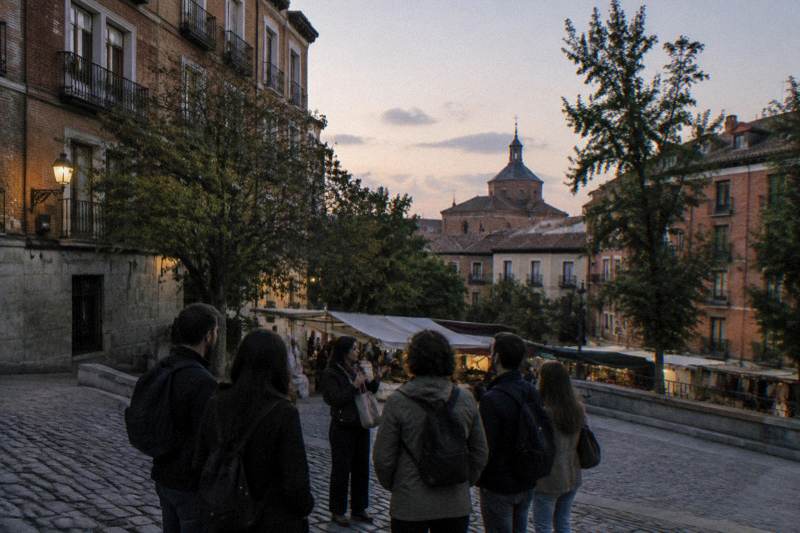
Malasaña Madrid: Free Things To Do In The Neighbourhood Of Squares And Street Art
Malasaña is the neighbourhood Madrid goes to when it wants to misbehave, and almost none of it charges admission. This guide walks the squares, the street art, the free museums on its doorstep and the sunset at its western edge, with every free-entry rule stated exactly.
Short answer
Malasaña costs nothing to explore: its squares, street art and shop windows are all free, the Museo de Historia de Madrid is free year-round with no conditions, the Museo del Romanticismo is free Saturdays from 14:00 and all day Sunday, and the Templo de Debod park and sunset viewpoint are always free.
Malasaña sits immediately north of the city's grand ceremonial axis, wedged between Gran Vía and the older streets around Fuencarral, and it is the part of Madrid where the historic street grid has been left to go slightly feral. Painted shutters, record shops, bars the size of a wardrobe and murals that change with the seasons: none of it has a ticket booth. The neighbourhood takes its name from the Dos de Mayo uprising against Napoleon's troops, an event commemorated at its central square, and that scrappy, anti-authoritarian reputation still shapes its character.
This guide covers what is genuinely free in and around Malasaña, with the free-entry rules stated exactly as they work rather than blurred together. It also flags the one museum people often add to a Malasaña day that you currently cannot visit in full, and the sunset spot at the neighbourhood's western edge where two different free rules apply to the same site.
Where Is Malasaña And What Does A Visit Cost?
Malasaña is the compact rectangle of streets between Gran Vía to the south, Calle de San Bernardo to the west, Calle de Fuencarral to the east and roughly Calle de Alberto Aguilera to the north, and visiting it costs nothing: there is no admission charge anywhere in the neighbourhood itself. Every square, street-art wall and shop window is free to enjoy, and the museums within walking distance have their own specific free rules. The neighbourhood was historically called the Universidad quarter after the old university buildings on Calle de San Bernardo, and older residents still use that name. Its current identity as Madrid's counterculture heart goes back decades, and the streets carry the evidence: murals on party walls, vintage shopfronts, and bars that look like someone's living room.
The practical point for a budget visitor is that Malasaña rewards walking and lingering rather than ticketed attractions. There is no single monument here in the way the Royal Palace anchors the Austrias district. Instead the neighbourhood's value is distributed across its public space, which is precisely why a free visit works so well. You can spend a full afternoon here without spending a cent on anything but coffee, and the coffee is optional.
For orientation, the whole walkable core fits between two metro stops: Bilbao at the northern corner and Tribunal at the eastern edge, with San Bernardo and Noviciado filling in the west. Gran Vía's stations sit on the southern boundary. Everything described in this guide is within fifteen minutes on foot of Plaza del Dos de Mayo, the neighbourhood's centre of gravity. If you are building a wider plan around free Madrid, the pieces in Free Things To Do In Madrid slot around this neighbourhood neatly, because Malasaña sits between most of the city's headline free sights rather than off to one side.
Plaza Del Dos De Mayo And The Free Squares Of Malasaña
Plaza del Dos de Mayo is Malasaña's main square and its historical heart, free to enter like every public square in Madrid, and it commemorates the Dos de Mayo uprising with a monument to the artillery officers Daoíz and Velarde, who died resisting the French occupation. Around it cluster smaller squares, terraces and the neighbourhood's densest street art, all costing nothing to see. The square's arch is one of the most photographed corners of central Madrid, and on any warm evening it fills with people who have bought nothing from anyone. That is the essential character of the place: it functions as the neighbourhood's living room, and living rooms do not charge admission.
The history matters more than most visitors realise. The rising against the French began in this part of the city, and the square's monument marks the spot where the artillery barracks stood. Malasaña's later reputation as a centre of protest, alternative culture and the movida madrileña, the creative explosion that followed the dictatorship's end, grew directly out of that legacy. A square that celebrates resistance tends to keep a resistant streak, and the neighbourhood's shops, murals and bar culture all carry it.
A few streets east, Plaza de San Ildefonso offers a smaller, narrower version of the same scene, with food stalls and terraces where browsing costs nothing even when the drinks do. Further toward Fuencarral, the shopping street itself is a free spectacle of window displays and street performers. The honest framing is this: Malasaña's squares are free, the terraces on them are not, and nobody will pressure you to sit down. Water in hand, you can occupy a step on the Dos de Mayo arch for an hour and spend nothing.
Many visitors arrive from the south, from Plaza Mayor or Puerta del Sol, and that walk in sets up the neighbourhood well. The Original Free Tour, a freetour.com walk rated 9.3 out of 10 across 21,435 reviews, meets at Plaza Mayor in front of the Tourist Information Centre and runs two and a half hours in English and Spanish, ending within easy reach of Malasaña's streets. Tipping etiquette for pay-what-you-want walks confuses first-timers, and the guidance in how much to tip a free walking tour answers it plainly. As an orientation to the older city before you dive into the newer street culture, the format works.
If you would rather compare several orientation walks before committing an afternoon, the selection below gathers the strongest free options that overlap this neighbourhood's ground.
Free Museums On Malasaña's Doorstep
Two museums near Malasaña are free year-round with no conditions, both run by the city rather than the state: the Museo de Historia de Madrid on Calle de Fuencarral and the Museo de San Isidro further south. The state-run Museo del Romanticismo, a short walk east, is free Saturdays from 14:00 and all day Sunday, plus four fixed dates: 18 April, 18 May, 12 October and 6 December. The distinction between the two museum networks matters, because their free rules are not the same shape. Municipal museums are simply free, always, walk in. State museums each have their own window, and the Romanticismo's window is the Saturday-afternoon-plus-Sunday pattern shared by several of Madrid's smaller state museums, with the four bonus dates attached.
The Museo de Historia de Madrid is the one that belongs most naturally to a Malasaña day. It occupies a former hospice on Fuencarral's eastern side and tells the story of the city from its origins through to the modern era, with the neighbourhood's own history woven through the rooms. Because it is municipal, there is no free-hours calculation to make: the general admission is free at any opening time, and the only thing you spend is attention. The Museo de San Isidro, dedicated to the city's patron saint and its archaeology, carries the same unconditional rule.
The Museo del Romanticismo, in the Justicia quarter east of Malasaña, is worth the short walk for its preserved period interiors, and its free window rewards a weekend visit. Plan it for a Saturday afternoon or a Sunday. The Museo Sorolla is the one to strike from your list for now: the museum has been closed since 1 October 2024 for a major expansion, and only the new extension building, entered from Zurbano 68, opens to the public on 15 October 2026. The historic house-museum and Sorolla's studio remain closed for further rehabilitation for several more months, so a visit gets you the new wing, not the painter's home.
| Museum | Network | Free entry rule |
|---|---|---|
| Museo de Historia de Madrid | Municipal | Free general admission year-round, no conditions |
| Museo de San Isidro | Municipal | Free general admission year-round, no conditions |
| Museo del Romanticismo | State | Saturdays from 14:00 and all day Sunday, plus 18 April, 18 May, 12 October and 6 December |
| Museo Sorolla | State | Closed since October 2024; new extension opens 15 October 2026, historic house and studio remain closed |
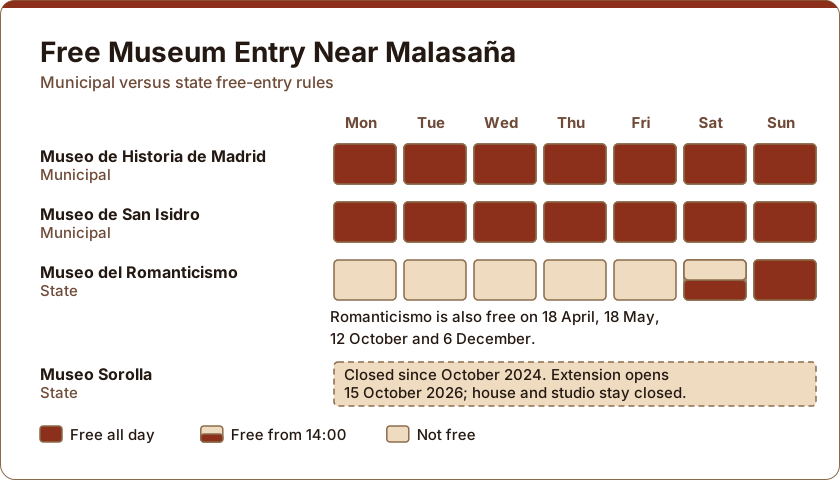
The pattern in that table is worth internalising, because it holds across Madrid. Free things in this city divide into the unconditional and the conditional, and the museums near Malasaña give you one clean example of each. If your visit falls on a weekday, the municipal pair is your guaranteed museum day; if it falls on a weekend, add the Romanticismo. For the wider picture across the city, including the big state museums' evening windows, the best free and budget museums in Madrid lays out every rule in one place.
A free walking tour pairs well with a museum morning, and if the freetour.com walk above is full on your date, the city's GuruWalk roster offers strong alternatives that cover the same central ground with the same pay-what-you-want model.
Street Art And Vintage Window Shopping In Malasaña
Malasaña's street art and vintage shops cost nothing to browse: the murals are on public walls around Calle de la Palma, Corredera Alta de San Pablo and Calle del Pez, and the vintage shop windows along those same streets are free to inspect whether or not you ever go inside. There is no gallery, no ticket and no route you must follow. The neighbourhood functions as an open-air exhibition that repaints itself, and the honest way to see it is slowly, on foot, with no schedule. Some walls are commissioned; others appear overnight and last until the next artist claims the space. Both kinds are visible from the pavement at no cost.
The vintage scene deserves the same framing. Madrid's second-hand shops in this neighbourhood are dense enough that window shopping is a genuine activity, not a consolation prize. Record stores, clothing shops and bookshops cluster along Calle del Pez and the streets running off Dos de Mayo, and unlike a department store, the stock changes weekly. If you are travelling on a tight budget, the Madrid on a budget guide covers where free browsing turns into cheap eating, which is the natural next question after an afternoon of walking these streets.
| Zone | What you see for free |
|---|---|
| Calle de la Palma | Independent shopfronts, painted facades and small murals between Dos de Mayo and Noviciado |
| Corredera Alta de San Pablo | Some of the neighbourhood's largest street-art walls, best in afternoon light |
| Calle del Pez | Vintage clothing and record shop windows, densest concentration in the barrio |
| Plaza del Dos de Mayo | The arch, the Daoíz and Velarde monument and the surrounding painted facades |
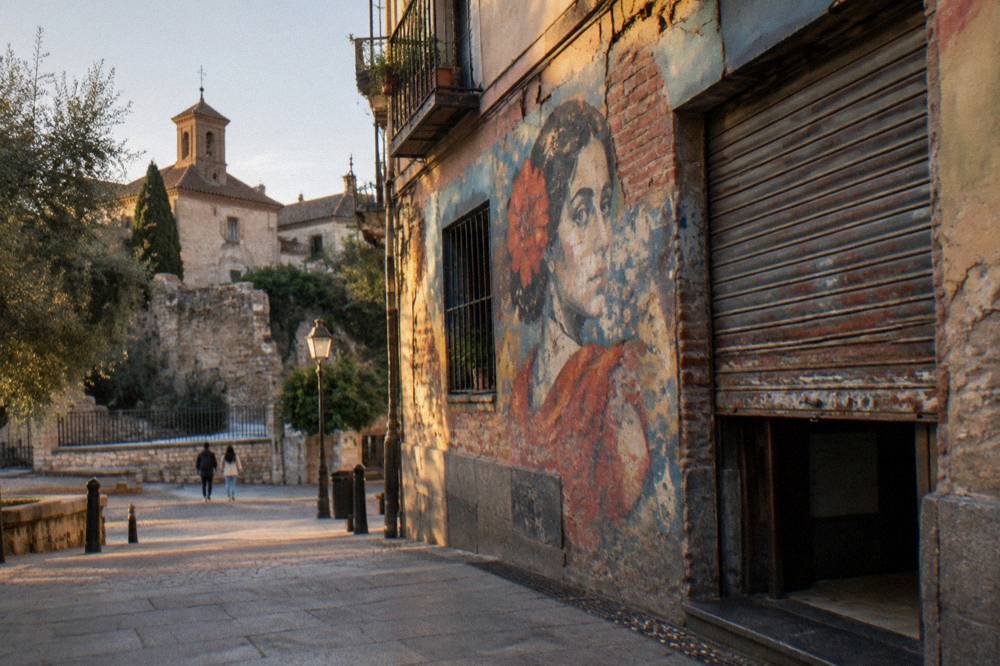
First-time visitors often ask whether an orientation walk helps before striking out alone, and in a neighbourhood this dense it genuinely does. Three GuruWalk essentials fit the bill: OgoTours Small-Group Essentials, rated 4.93 out of 5 across 174 reviews, the 2-Hour Historical Center Walk, rated 4.76 out of 5 across 200 reviews, and Essentials, 2 Hours 15, rated 4.91 out of 5 across 164 reviews. All three are pay-what-you-want, all cover the central grid that Malasaña hangs from, and each meets within a short walk of the neighbourhood's edge. Picking one and tipping at the end costs less than a museum ticket anywhere else in Europe.
The Walk Out: Sol, Austrias And The Free Landmarks On The Way
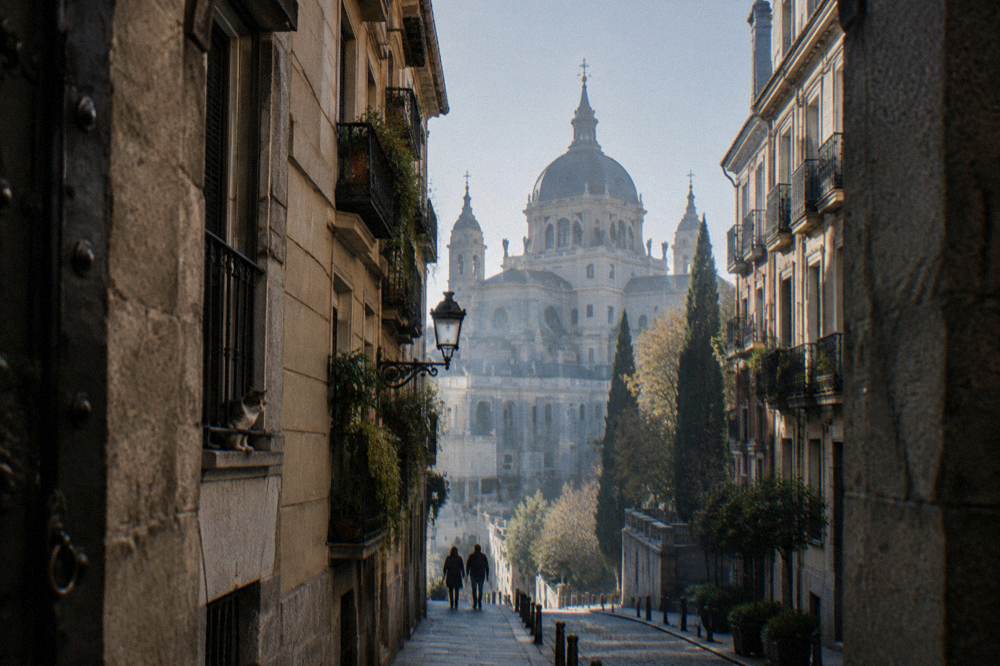
Puerta del Sol and Plaza Mayor, both free public spaces, sit ten minutes' walk south of Malasaña, and the streets between them and the Royal Palace form a corridor of free landmarks: the Palacio Real has a free self-guided window for EU and Latin American residents via the ticket office only, and the Catedral de la Almudena's nave and crypt are free, with an optional one-euro donation for the crypt. This is the walk most visitors make without planning it, because Malasaña's southern edge simply spills into the old city. The corridor rewards a deliberate pass rather than a hurried one.
Puerta del Sol is Madrid's kilometre zero, the point from which the country's road distances are measured, and it costs what every square costs: nothing. From there the route west crosses the Austrias quarter's oldest streets toward the palace. The Old Town Walk, Five Languages, a GuruWalk walk rated 4.92 out of 5 across 10,008 reviews, meets at Kilometer Zero in the centre of Puerta del Sol and covers exactly this ground in English, Spanish, French, Italian and Portuguese over two and a quarter hours. It is the largest single GuruWalk walk on Madrid's roster, and its route overlaps the walk out of Malasaña almost street for street.
The Royal Palace anchors the far end of that corridor. Its free window is specific: self-guided visits for EU and Latin American residents, ticket office only, capacity-limited, so arriving early in the window matters. The palace's roof renovation reached its final phase in 2026, and visitor access has shifted to the Almudena Cathedral esplanade and Plaza de la Armería side, a change worth knowing before you navigate the building. The Royal Palace And Theatre Walk, a GuruWalk walk rated 4.89 out of 5 across 1,976 reviews, meets at the El Oso y el Madroño statue in Puerta del Sol and covers the palace district in English, Spanish, French and Italian over two and a half hours. For the full free-entry mechanics, the Royal Palace Madrid free entry guide lays them out step by step.
The cathedral beside the palace carries its own honest pair of facts. The nave is free to enter during daily opening hours, and the crypt is likewise free with an optional one-euro donation, while the cathedral museum and guided tours are separately paid. The cathedral's own visitor page states the current arrangement: the cathedral's daily hours and donation practice. For a free-attractions sweep that includes this whole southern corridor, free things to see in Madrid covers each landmark's rule without blurring them.
Templo De Debod And The Sunset At Malasaña's Western Edge
Templo de Debod is two free facts in one place: the surrounding park, the temple's exterior and the famous sunset viewpoint are always free with no booking, while the temple's interior is also free but gated by a mandatory advance timed reservation rather than a ticket price. The site closes on Mondays. The constraint on the interior is booking, not money, and that distinction is worth stating plainly because most guides blur it. You cannot simply walk into the temple chamber, but you can stand beside it at sunset for nothing, and the sunset is the reason most people come.
The temple itself is a genuine ancient Egyptian structure, donated to Spain after the damming works that would have submerged it, and reassembled in the Parque del Oeste beside the Parque de la Rosaleda. From Malasaña's western edge it is a straightforward walk, and the parkland between is free public space throughout. The viewpoint behind the temple, looking across the Casa de Campo toward the Sierra, is one of the city's signature free experiences, and it costs nothing but the patience to arrive before the crowd. The site's fragility has even prompted a public ideas contest for its protection, as reported in a recent ABC piece on the Debod protection contest.
| Part of the site | Access rule |
|---|---|
| Park, exterior and sunset viewpoint | Always free, no booking, no conditions |
| Temple interior | Free, but requires an advance timed reservation; closed Mondays |
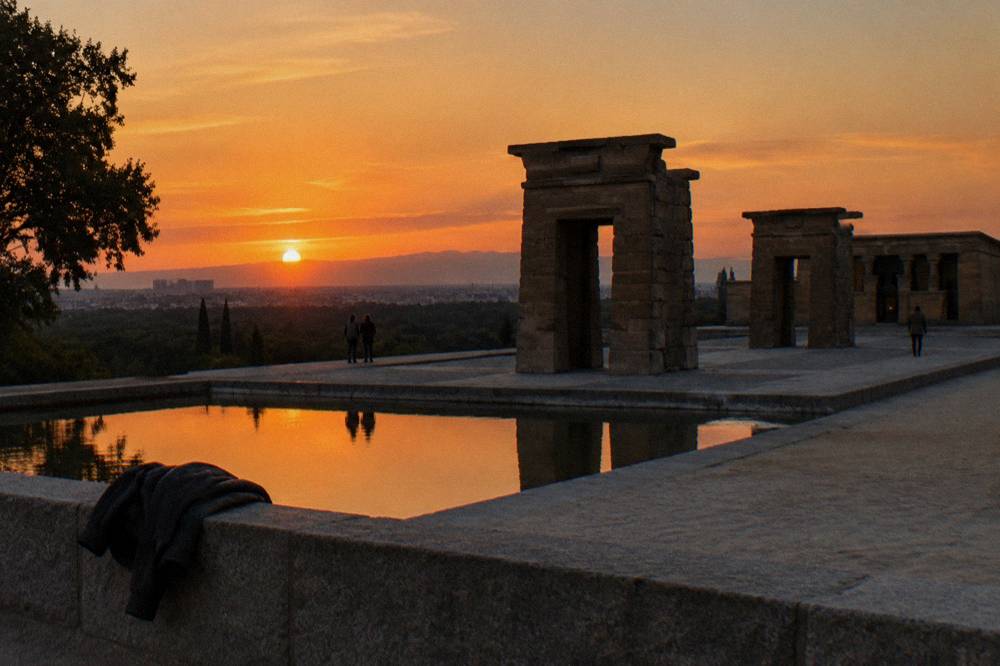
The Templo de Debod guide covers the reservation mechanics and the best viewing angles in detail, and it is worth reading before an evening here, because the reservation window fills on good-weather days. Pairing the sunset with a Malasaña dinner afterwards closes the loop neatly: the walk back east takes you through the neighbourhood's liveliest streets at the hour they come alive.
Free Evenings And Seasonal Events Around Malasaña
Malasaña's calendar includes genuinely free city events: the Veranos de la Villa festival ran 7 July to 29 August 2026 across 14 districts with dozens of free activities, and the Madrid Otra Mirada heritage open days on 12 to 18 October 2026 open 205 normally closed patrimonial sites free with 249 activities, registration required. These are the neighbourhood's best-kept free opportunities, because they change the arithmetic of an October or summer visit entirely. A trip that lands on the right week gets access to buildings and courtyards that no amount of money buys the rest of the year.
Beyond the festivals, Malasaña's ordinary evenings are free theatre of their own. The neighbourhood's bar culture spills onto the streets, street musicians work the squares, and the murals look different under lamplight than in afternoon sun. None of this requires a purchase, and the local custom is tolerant of people who simply wander. If your evening tastes run darker, the city's free-walk roster has a whole nocturnal strand: the Dark Side And Terror Walk, a GuruWalk walk rated 4.9 out of 5 across 786 reviews, covers Madrid's ghost stories and executions in English and Spanish. The Medieval At Dusk walk, rated 4.97 out of 5 across 553 reviews, runs in English only and ends at the Templo de Debod at sunset, folding the viewpoint above into a guided walk. The Civil War, Guernica And Franco walk, rated 4.89 out of 5 across 616 reviews, takes the same streets' wartime history seriously in English and Spanish. All three are pay-what-you-want on GuruWalk.
A Free Half-Day Route Through Malasaña
A free half-day in Malasaña runs about four hours on foot: start at Tribunal or Bilbao metro, work the street art along Calle del Pez and Corredera Alta de San Pablo, pause at Plaza del Dos de Mayo, spend an hour in the free Museo de Historia de Madrid, and finish with the walk south to Sol or west to Templo de Debod for sunset. Total admission cost: zero. The route works in either direction, but the museum's opening hours and the sunset's timing are the two fixed points, so decide which anchor matters more and build outward from it.
| Time | Stop | Cost |
|---|---|---|
| 16:00 | Calle del Pez and Corredera Alta de San Pablo street art | Free |
| 17:00 | Plaza del Dos de Mayo and the arch | Free |
| 17:30 | Museo de Historia de Madrid | Free year-round, no conditions |
| 19:00 | Walk south through Fuencarral to Puerta del Sol | Free |
| 19:30 | Plaza Mayor and the walk west toward the palace district | Free |
| 20:30 | Templo de Debod viewpoint for sunset | Free, no booking |
Adjust the clock for the season, since Spanish sunsets shift dramatically between June and December. The museum is the one stop with a closing time to respect, and the municipal free rule means no queue calculation is needed. If you would rather hand the orientation to a guide and keep your planning energy for the neighbourhood itself, the evening and specialist walks below cover the same ground with the same pay-what-you-want freedom.
Common Questions About Free Things To Do In Malasaña
Is Malasaña worth visiting?
Yes, and for budget travellers it is one of Madrid's best-value neighbourhoods precisely because its attractions are public space: squares, street art, murals and shop windows, none of which charge admission. The free Museo de Historia de Madrid anchors a visit with substance, and the neighbourhood sits between the old city's free landmarks and the Templo de Debod sunset viewpoint.
What is Malasaña known for?
Malasaña is known for its role in the Dos de Mayo uprising against Napoleon's troops, commemorated at Plaza del Dos de Mayo, and for its later identity as Madrid's counterculture heart, home to street art, vintage shops, record stores and the bars of the movida madrileña era. It is a neighbourhood of public life rather than ticketed monuments.
Is the Museo de Historia de Madrid free?
Yes, completely. It is a municipal museum run by the city of Madrid, and its general admission is free year-round with no conditions, no free-hours window and no booking requirement. This is a different rule from the state museums, which each have their own specific free windows.
When is the Museo del Romanticismo free?
The Museo del Romanticismo is free on Saturdays from 14:00 and all day Sunday, plus four fixed dates each year: 18 April, 18 May, 12 October and 6 December. It is a state museum, so its rule differs from the unconditional free admission of the municipal museums.
Is Museo Sorolla open?
Not in full. The museum has been closed since 1 October 2024 for expansion and rehabilitation. Its new extension building, entered from Zurbano 68, opens to the public on 15 October 2026, but the historic house-museum and Sorolla's studio remain closed for several additional months.
Is Templo de Debod free?
The park, the temple's exterior and the sunset viewpoint are always free with no booking. The temple interior is also free, but it requires a mandatory advance timed reservation rather than a ticket purchase, and the site is closed on Mondays. The constraint is booking, not price.