Is El Rastro Free?
Browsing El Rastro, Madrid's Sunday flea market in La Latina, costs nothing. Here is what is genuinely free, what you will pay for, and how to pair the market with free sights nearby.
Is El Rastro Free?
Yes, El Rastro is free to browse. The market charges no entry fee, no gate, and no ticket: wandering the stalls and the surrounding La Latina streets costs nothing at all. The only money you can spend is on things you choose to buy, or on tapas and drinks in the bars around the market.
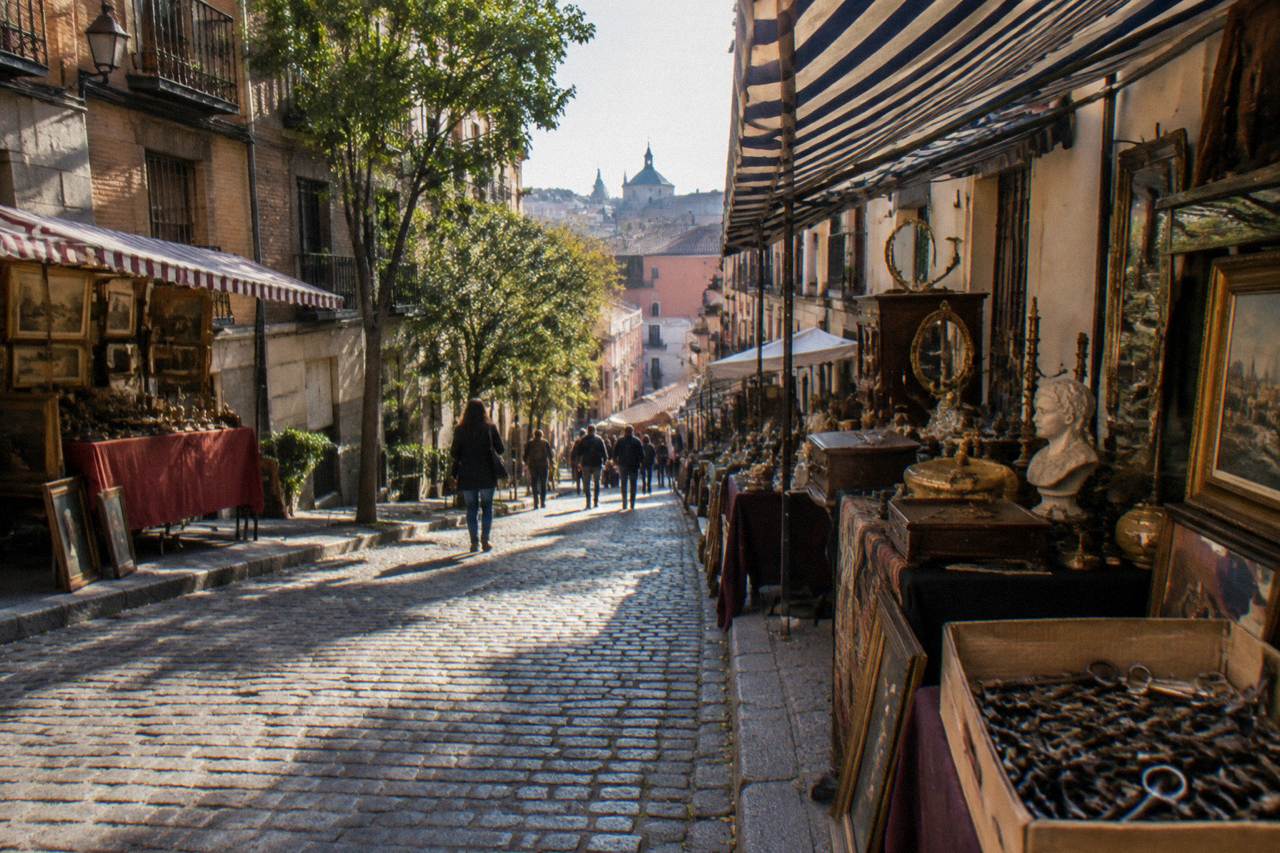
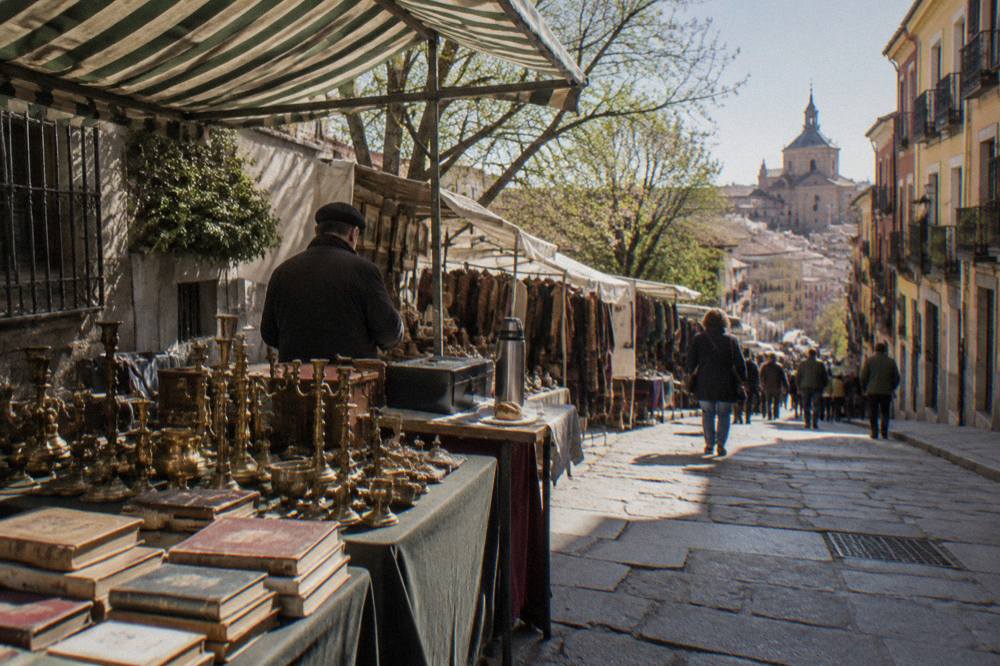
That single fact surprises people who assume a market this famous must be ticketed. It is not. El Rastro is a public street market that happens in the open air of La Latina every Sunday, and like any public street, walking through it is free. Vendors set out antiques, clothes, prints, records, old postcards, tools, and assorted curiosities, and browsing is the whole point. You could spend three hours here and part with nothing but shoe leather. The market has occupied this corner of Madrid for centuries, and in all that time nobody has charged admission to walk down a public hill.
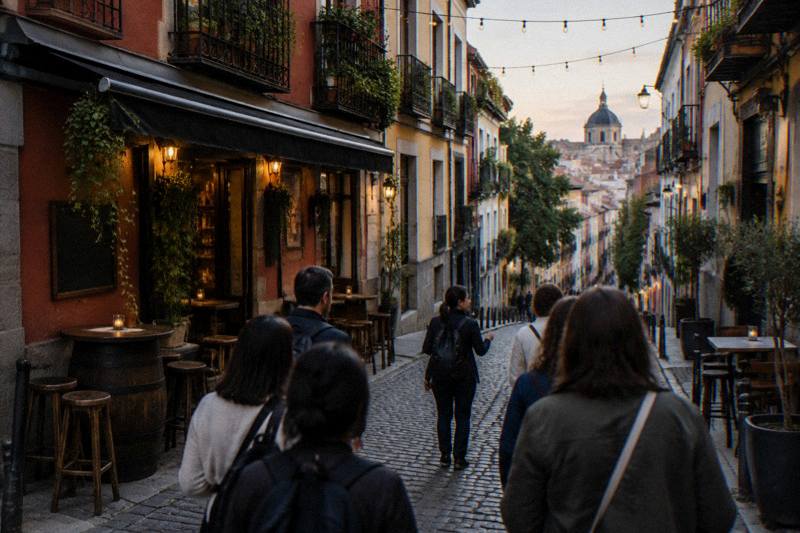
The stalls spread across the streets around Calle de la Ribera de Curtidores, the sloped lane that runs down from Plaza de Cascorro at the edge of La Latina, one of Madrid's oldest neighbourhoods. The surrounding squares, churches, and tavern-filled lanes cost nothing to explore either. If you want the full route through the neighbourhood, with the streets, the squares, and the free sights you pass between stalls, the La Latina Sunday market walk guide lays it out step by step.
Because the market only runs on Sundays, a Sunday visit slots naturally into a free-weekend plan. Many travellers pair the morning at El Rastro with a free walking tour later in the day, since several of Madrid's best pay-what-you-want walks meet within a few minutes' walk of the market's edges, at Plaza Mayor or Puerta del Sol. The trio below is a fair starting shortlist: the Original Free Tour from freetour.com, a Royal Palace and Theatre walk, and a Retiro and Gran Vía route, all pay-what-you-want and all starting close enough to reach on foot from the market.
What Actually Costs Money At El Rastro?
Only purchases and food. The stalls are run by independent vendors, so anything you buy, from a vintage poster to a secondhand jacket, is negotiated and paid for like any market purchase. Tapas and drinks in La Latina's bars are paid. There is no entry charge, no browsing fee, and no obligation to buy anything at all.
Haggling is part of the culture at a flea market, and prices at the stalls are set by individual sellers rather than by any central authority. Treat quoted prices as opening positions, particularly on antiques and secondhand goods. Cash is still the practical currency here; many stallholders do not take cards, and the small bars nearby often prefer cash too. None of that changes the entry price, which stays zero no matter how the negotiation goes.
The spending risk at El Rastro is not the market itself, it is the neighbourhood around it. La Latina is one of the best tapas districts in Madrid, and the bars fill with the Sunday market crowd from late morning onward. A caña and a tapa here is a paid pleasure, a good one, but paid. If you are tracking a budget across the whole trip, it helps to decide before you arrive how much of the day belongs to the free layer and how much to the paid one, because La Latina will tempt you toward the second with every passing doorway.
For orientation before market day, the Original Free Tour is a strong fit. It meets at Plaza Mayor, in front of the Tourist Information Centre, which sits on the market's doorstep, runs two hours 30 minutes in English and Spanish, and it is a freetour.com listing rated 9.3 out of 10 across 21,435 reviews. Because it is pay-what-you-want, the price is genuinely whatever you decide at the end. See this free tour on the freetour.com listing, or read the free walking tour overview first to compare it against the other pay-what-you-want options.
A useful frame for the whole day is to separate the free layer from the paid layer before you leave the hotel. The table below splits the neighbourhood's main draws into what costs nothing and what does not, using the site's verified free-attraction records, including the closures that catch visitors out.
| Attraction near the market route | Free or paid | The condition, stated plainly |
|---|---|---|
| El Rastro stalls (browsing) | Free | No entry charge; only purchases cost money |
| Mercado de San Miguel (browsing) | Free | Free to enter and wander; food and drink are paid |
| Catedral de la Almudena (nave and crypt) | Free | Crypt asks an optional EUR 1 donation; the museum is separately paid |
| Jardines de Sabatini | Free | Open public gardens next to the Royal Palace |
| Palacio de Cristal del Retiro | Currently closed | Closed for a roughly EUR 7.5M renovation, targeted to reopen around July 2027 |
| CaixaForum Madrid | Paid | EUR 6 general entry; free only on fixed annual dates |
Two of those rows deserve a second look. The Almudena Cathedral's nave and crypt are free, with an optional EUR 1 donation in the crypt, though the cathedral museum is separately paid, an arrangement the cathedral's own site sets out. And Palacio de Cristal, the glasshouse in Retiro that many free-Madrid lists still describe as open, is closed for renovation and will not reopen until around July 2027, so do not build a Sunday around it.
When Does El Rastro Happen?
El Rastro runs on Sundays. It is a Sunday institution in La Latina, and that is the day the stalls, the crowds, and the full street-theatre atmosphere exist. On every other day of the week the same streets are ordinary residential lanes, quiet and free to walk but with no market to browse. Plan around the calendar, not the clock.
The market's rhythm is generally a morning-into-early-afternoon affair, with the busiest stretch in the late morning, when the whole neighbourhood feels closer to a street festival than a shopping trip. Arriving early means thinner crowds and first pick of the antiques stalls. Arriving later means more atmosphere and better people-watching. Neither choice costs anything, and neither requires a booking of any kind. What you cannot do is show up on a Tuesday and expect the market: the stalls simply are not there, and the streets revert to their everyday quiet.
Sunday also happens to be one of the strongest days for free Madrid generally, which makes the market a natural anchor for a fully free day. The Prado's free access covers the final two hours, from 17:00 to 19:00 on Sundays and public holidays, collection only, with a walk-up ticket required and capacity limits in force. Reina Sofía's free Sunday slot runs 12:30 to 14:30, individuals only. A day that starts with free browsing at El Rastro can therefore end with free Velázquez or free Picasso, which is about as good as a free Sunday gets anywhere in Europe.
Where Does El Rastro Start And How Far Does It Spread?
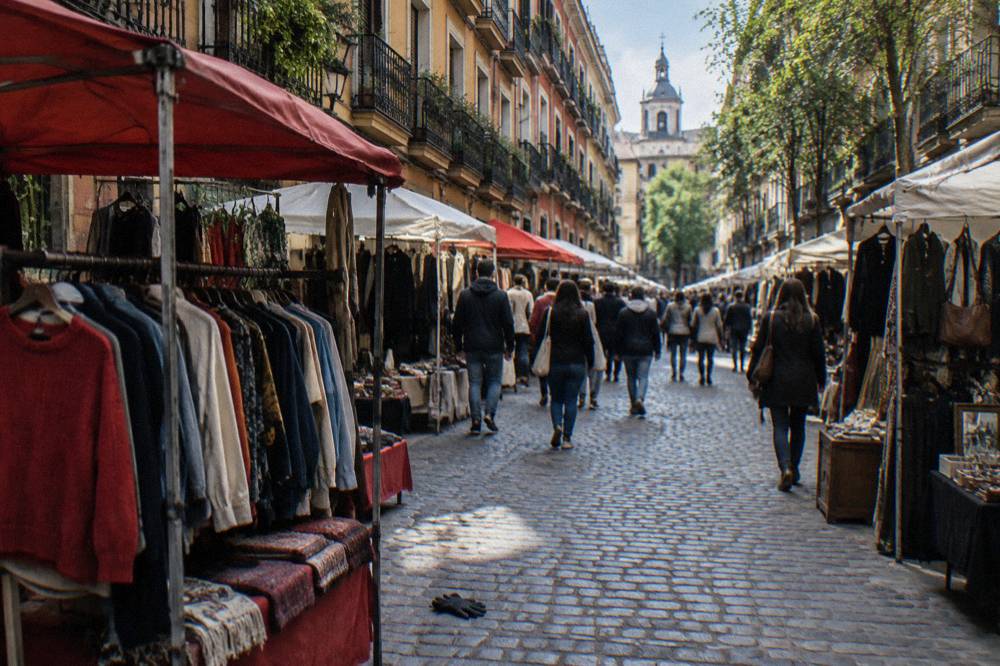
The market's anchor is Plaza de Cascorro, and its spine is Calle de la Ribera de Curtidores, the sloped street running downhill from there. From Cascorro the stalls spread into the side streets and plazas of La Latina on both sides, and the whole sprawl is walkable in an easy loop. Everything you see from the pavement is free.
Most visitors arrive by metro and surface at La Latina station, which drops you a couple of streets from the market's heart. From there the route is hard to get wrong: follow the crowd. The Ribera de Curtidores slope is the spine, and the stalls thicken as you walk downhill, spilling into side lanes wherever there is room. Plaza Mayor sits a short walk to the north, which is why several of the site's featured free tours meet there on Sunday mornings, steps from where the market ends.
The spread matters for planning because El Rastro is not a single square you can tick off in ten minutes. It is a neighbourhood-scale event. Give it a slow loop: down the spine, through a side street or two, into one of the small plazas where the bars spill tables out, and back up a parallel lane. The loop costs nothing, takes an hour or two at browsing pace, and covers the market the way it deserves to be covered.
On non-market days the same walk is still pleasant and still free, but it is a different product: quiet lanes, closed shutters, and the everyday La Latina that locals get the other six days of the week. If your trip has no Sunday in it, the one day free itinerary shows how to cover La Latina alongside the rest of central Madrid in a single free day.
What Will You Actually Find On The Stalls?
Stall goods, and only stall goods. Expect antiques, secondhand clothes, vintage posters and prints, records, books, old photographs, tools, costume jewellery, and a long tail of curiosities that resists categorising. Nothing on the tables is free, everything on the pavement around them is, and the browsing experience is identical whether you spend or not.
The goods skew old, cheap, and characterful. Antiques and collectibles tend to cluster near the top of the slope, where the serious dealers set up early and the serious hunters arrive even earlier. Further down, the mix shifts toward clothes, shoes, and household goods, with the ratio of treasure to junk part of the fun. Prints and old photographs of Madrid make popular souvenirs precisely because they are light, cheap, and impossible to find in a shopping centre.
Haggling is expected on the secondhand and antique stalls, less so on new goods with price tags. A polite counter-offer, a smile, and a willingness to walk away will do more for the price than any script. As a planning rule, treat everything as sold-as-seen: check condition before handing over money, because there is no returns desk at the bottom of the hill.
One genuinely free pleasure hiding beside the market is the food hall nearby. Mercado de San Miguel, a short walk north, is free to enter and wander, with food and drink paid, so it works as a free spectacle with an optional price tag. The same logic governs El Rastro end to end: the spectacle is free, the goods are not, and the two layers never blur into each other.
How Do You Pair El Rastro With Free Madrid Sights?
Combine the market morning with a free afternoon within walking distance. From La Latina you can walk to the Royal Palace's free resident window, the Sabatini gardens, the Almudena Cathedral, or Retiro Park, all free or conditionally free. A free walking tour bridges the gap, since several meet at Plaza Mayor or Puerta del Sol nearby.
The geography works in your favour. La Latina sits downhill from the Royal Palace complex, so the walk from the market to the palace gardens takes ten to fifteen minutes through streets that are themselves worth the stroll. The Jardines de Sabatini and Campo del Moro are free public gardens with palace views. For residents of the EU and Latin America, the Royal Palace has a free entry window at the ticket office, capacity-limited and self-guided, so the palace joins the free column for a large share of visitors.
East of the centre, Retiro Park is always free to enter, though one of its two exhibition pavilions is currently out of action: Palacio de Cristal, the glasshouse, is closed for a glass-and-ironwork renovation and will not reopen until around July 2027, per reporting on the renovation. Its sibling, Palacio de Velázquez, went the other way: it reopened on 24 June 2026 after its own rehabilitation and is a free exhibition space now. Between the palace, the cathedral, the gardens, and Retiro, a market morning plus a walking afternoon covers a remarkable amount of free Madrid without a single fixed ticket.
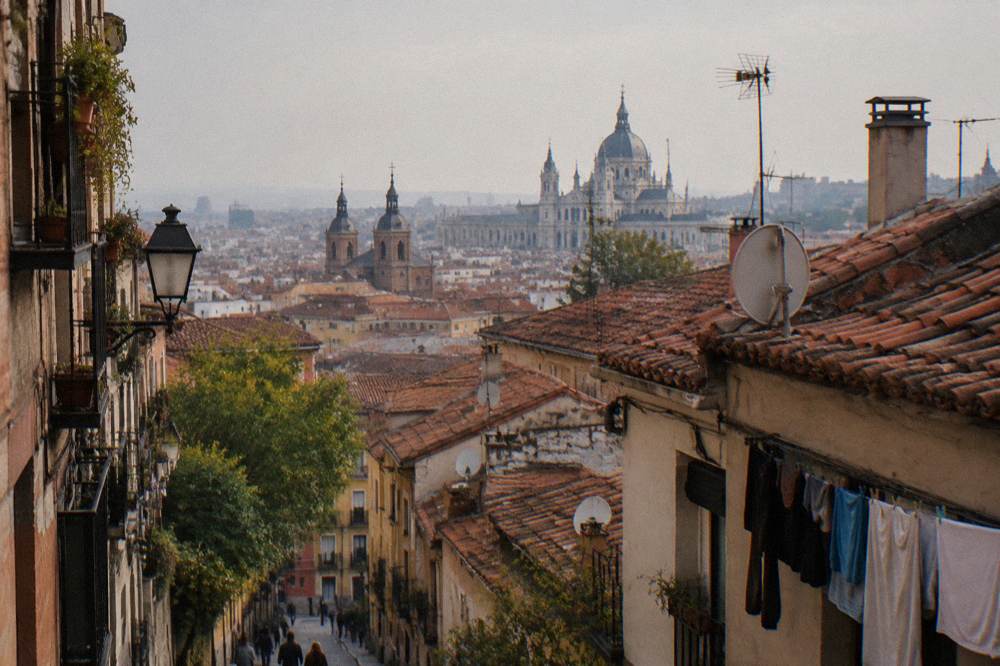
If you would rather have a guide join the dots between these sights, the Old Town Walk, Five Languages is the natural pick after a market morning. It is a GuruWalk listing rated 4.92 out of 5 across 10,008 reviews, the largest single GuruWalk walk on this site's roster. It meets at Kilometer Zero in Puerta del Sol, a short walk up from La Latina, runs two hours 15 minutes, and offers English, Spanish, French, Italian, and Portuguese. Like everything in the GuruWalk free-tour model, you pay what you want at the end.
That free layer is the reason this site exists at all: Free Things To Do In Madrid tracks the free hours, the free parks, and the pay-what-you-want walks so a Sunday like this one can be built end to end without a fixed ticket anywhere in it. And if your Sunday falls inside Madrid Otra Mirada week, 12 to 18 October 2026, the free layer gets suddenly deeper, with 205 normally-closed patrimonial sites opening free, per coverage at the festival's launch, and registration having opened 29 September 2026.
What Should You Watch Out For At El Rastro?
Crowds, cash, and guarded pockets. El Rastro is packed shoulder-to-shoulder in the Sunday late morning, which makes it a pickpocket's ideal habitat, so guard bags and phones as you would on any packed street. Bring cash for anything you intend to buy, go early if you want room to browse, and treat quoted prices as opening positions.
The crowd density is the single biggest difference between El Rastro and a calm museum morning. There is no capacity control, no queue, and no way to buy your way out of the crush: the free market is free for everyone, and everyone comes. Keep valuables in front pockets or a closed bag, skip the backpack-as-daypack habit for a few hours, and take extra care in the bottlenecks where side streets meet the main slope.
The cash point from earlier bears repeating, because an empty wallet limits you to browsing even when you find something worth buying. There are cash machines in the surrounding streets, but Sunday queues for them can be their own minor attraction. Withdraw the day before if you like your market mornings frictionless.
A last practical note: the market is a morning thing, so plan the day in that order. Market first, then either the free sights around the palace and Retiro or a pay-what-you-want walk from Plaza Mayor or Puerta del Sol, and the Sunday more or less runs itself. None of it needs to be booked, paid, or reserved ahead, which is rather the point.
If a guided walk is how you prefer to anchor the afternoon, these three pay-what-you-want options all start within a short walk of the market's edges: the Original Free Tour on freetour.com, the Royal Palace and Theatre walk, and the Retiro and Gran Vía route.
Common Questions About El Rastro
Is El Rastro Free?
Yes. Browsing El Rastro costs nothing: there is no entry fee, no gate, and no ticket. The only money you can spend is on items you choose to buy from stalls, or on food and drink in La Latina's bars.
Do I need to book anything for El Rastro?
No. The market is a public street event. You simply show up on a Sunday and walk in. Booking only enters the picture if you add a guided tour, or a free-but-reserved attraction such as the Templo de Debod interior, which requires an advance timed reservation.
What day is El Rastro open?
Sundays only. The stalls and the full street atmosphere exist on Sunday, with the busiest stretch in the late morning. On other days the same streets are quiet residential lanes, free to walk but with no market.
Is El Rastro worth visiting if I buy nothing?
Yes. The browsing, the people-watching, and the surrounding La Latina architecture are the attraction, and all of it is free. Many visitors treat it as a free morning's entertainment and spend nothing beyond a coffee.
Can I combine El Rastro with free museums on the same Sunday?
Yes, easily. The Prado's free window runs the final two hours on Sundays, 17:00 to 19:00, and Reina Sofía's free Sunday slot is 12:30 to 14:30. A market morning plus a museum afternoon is a fully free Sunday in Madrid.
Are the bars around El Rastro free to enter?
Yes, entering any bar is free; you pay only for what you order. La Latina's taverns are ordinary Madrid bars, so standing at the counter with a single caña is as normal as ordering a full meal.