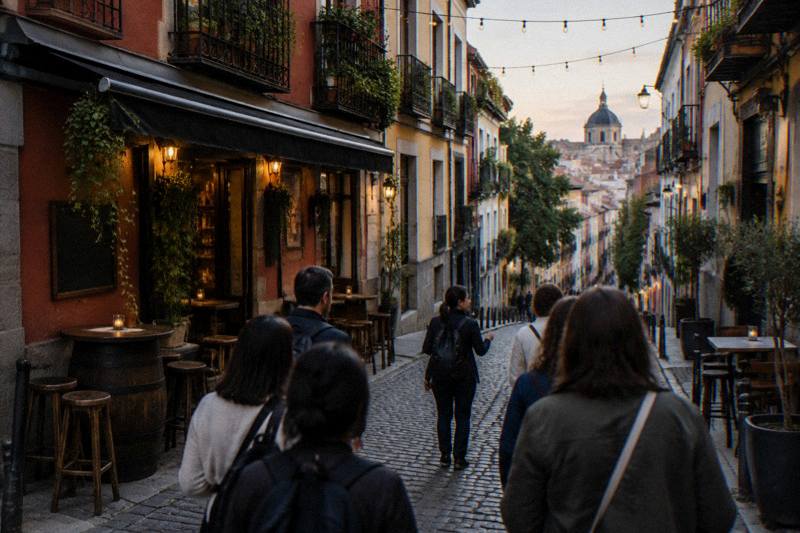
El Rastro And La Latina: A Free Sunday Market Walk In Madrid
El Rastro is the one Madrid event that costs nothing by default: the market itself is free to browse, and the streets around it hold some of the oldest architecture in the city. Here is how to walk the whole thing, what is genuinely free, and where the money goes if you let it.
Short answer
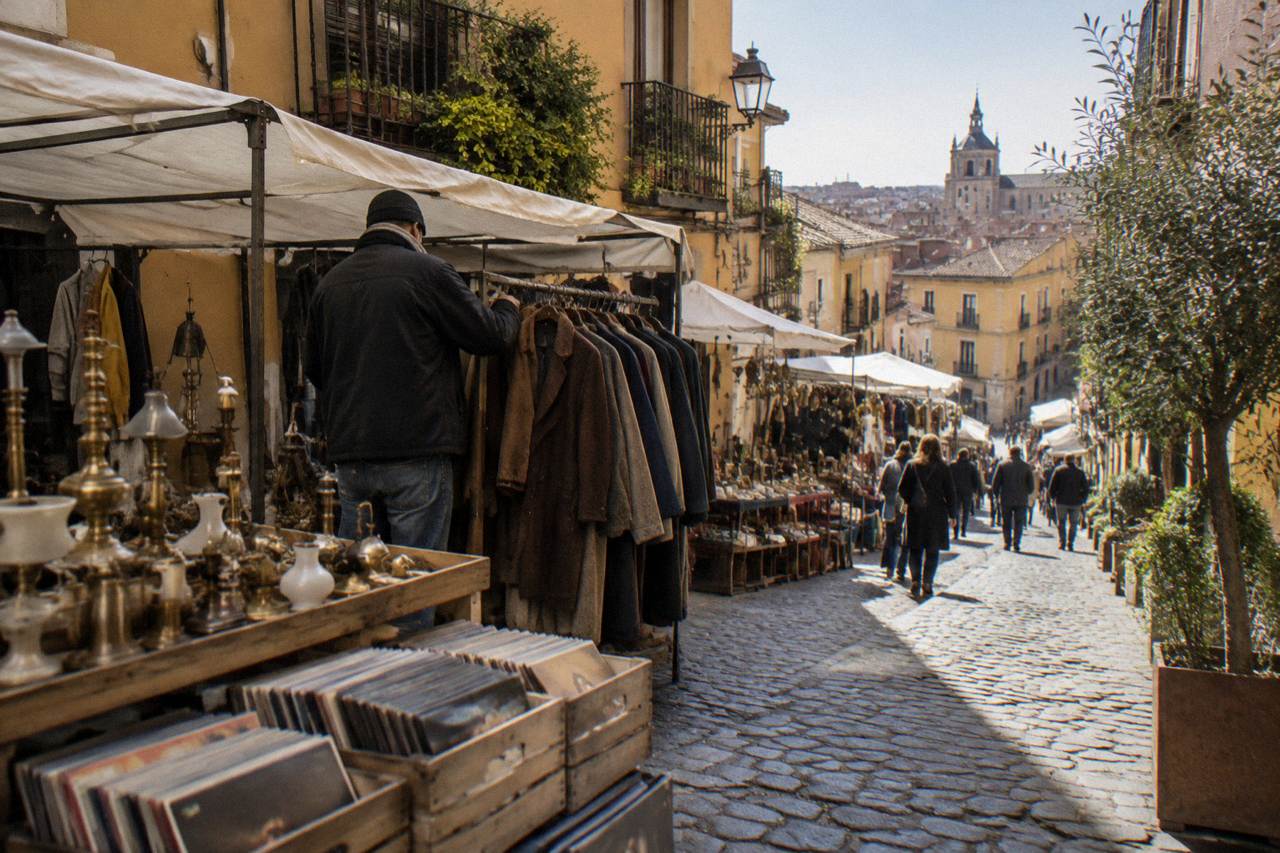
El Rastro runs every Sunday and public holiday along Calle de la Ribera de Curtidores, and browsing costs nothing. The surrounding La Latina streets, Plaza de la Cebada and the route toward the Royal Palace edge are all free public space. Only food, drinks and market purchases are paid, with tapas typically a few euros each.
El Rastro has been running for so long that nobody in Madrid calls it a flea market without a shrug. Every Sunday, the stalls spill down Calle de la Ribera de Curtidores from the Embajadores end toward Plaza de Cascorro, and by eleven in the morning the whole slope is a slow river of people. The market itself is the cheapest attraction in a city that already gives a lot away: browsing is free, the street theatre is free, and the historic La Latina quarter wrapped around it is one of the oldest street networks in Madrid, walkable without a ticket.
This guide lays out the full free walk, start to finish, with the honest cost notes attached. Browsing the market costs nothing. The tapas crawl afterwards does not, and pretending otherwise would be dishonest, so the budget section below gives realistic ranges rather than promises.
What Is The Free Sunday Walk Through El Rastro And La Latina?
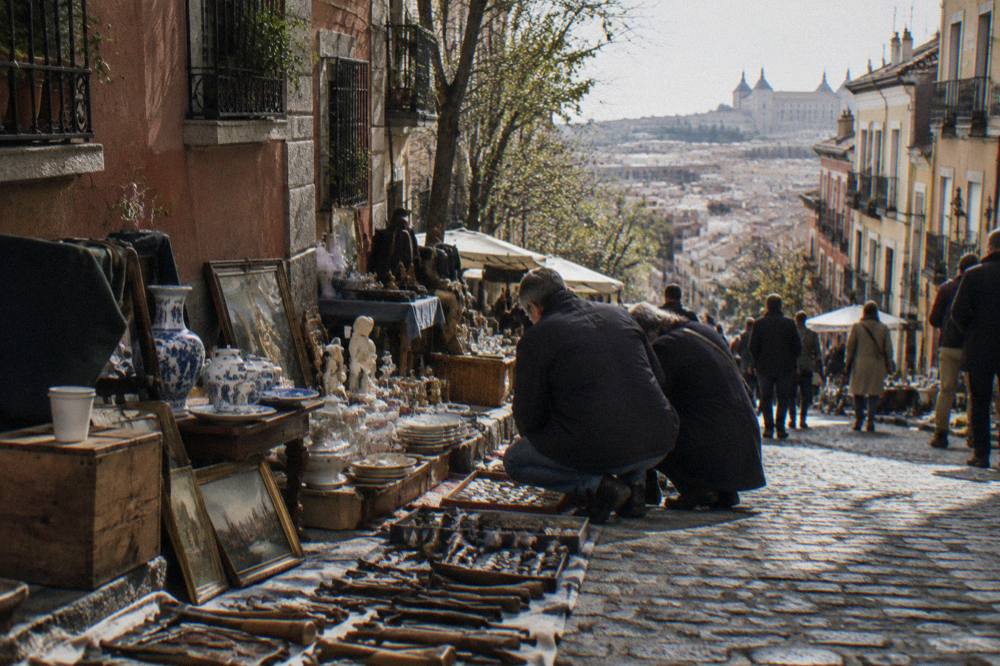
El Rastro is a weekly open-air flea market held every Sunday and public holiday in the La Latina quarter, roughly from 9:00 to 15:00, and browsing every stall costs nothing. The walk covers the market slope along Ribera de Curtidores, the historic streets of La Latina around Plaza de la Cebada, and the free public squares and viewpoints that connect them. Only food, drinks and anything you buy are paid.
The market's official spine is Calle de la Ribera de Curtidores, a sloped street running from Cascorro down toward the Ronda de Toledo end, with side streets fanning off it in both directions. Each side street has its own character: one clusters old posters and film memorabilia, another is almost entirely second-hand clothes, and the antique furniture tends to sit toward the upper end near Plaza de Cascorro. There is no entrance, no gate and no fee anywhere in the market.
The name matters to locals. "El Rastro" literally refers to the trail, the rastro, that slaughterhouse workers left in earlier centuries when they dragged carcasses down toward the river, and the market grew around the tanneries and curtidores, the tanners, who worked the slope. That history explains the street name you will be walking down, and it is the kind of detail a good guide adds texture with, but the walk itself needs no guide at all.
For planning, the practical facts are simple and stable:
| Fact | Detail |
|---|---|
| Market days | Sundays and most public holidays |
| Usual hours | Roughly 9:00 to 15:00, stalls pack up early afternoon |
| Main street | Calle de la Ribera de Curtidores |
| Entry cost | Free, browsing costs nothing |
| Nearest metro | La Latina (Line 5), Embajadores (Line 3), Puerta de Toledo (Line 5) |
| Best time to arrive | Before 11:00 for thinner crowds, or after 14:00 for haggling |
Where Does The Walk Start, And What Can You See For Free?
The most natural start is Plaza de Cascorro at the top of the market slope, reached by metro to La Latina, and the free sights begin immediately: the Cascorro monument, the market stalls themselves, and the historic streets fanning downhill. From there the route drops through the market to Puerta de Toledo, then loops back up through La Latina's squares. Nothing on this loop requires a ticket.
Plaza de Cascorro is the market's unofficial front door. The statue in the centre honours a Cuban War volunteer, and the square is where the stall density is highest, the antiques and collectables end of the market. From here the walk is downhill, which matters in August: the slope means you want to do the market top-to-bottom while you are fresh, not the reverse.
If you prefer a guided anchor before or after the market, The Original Free Tour of Madrid meets at Plaza Mayor, in front of the Tourist Information Centre, a ten-minute walk from Cascorro. It is a freetour.com listing, rated 9.3 out of 10 across 21,435 freetour.com reviews, runs two and a half hours in English and Spanish, and works on a pay-what-you-want basis. Because it starts at Plaza Mayor, it slots neatly onto the market morning: walk the market early, then take the afternoon tour, or take the tour first and hit the stalls when the midday crowds thin.
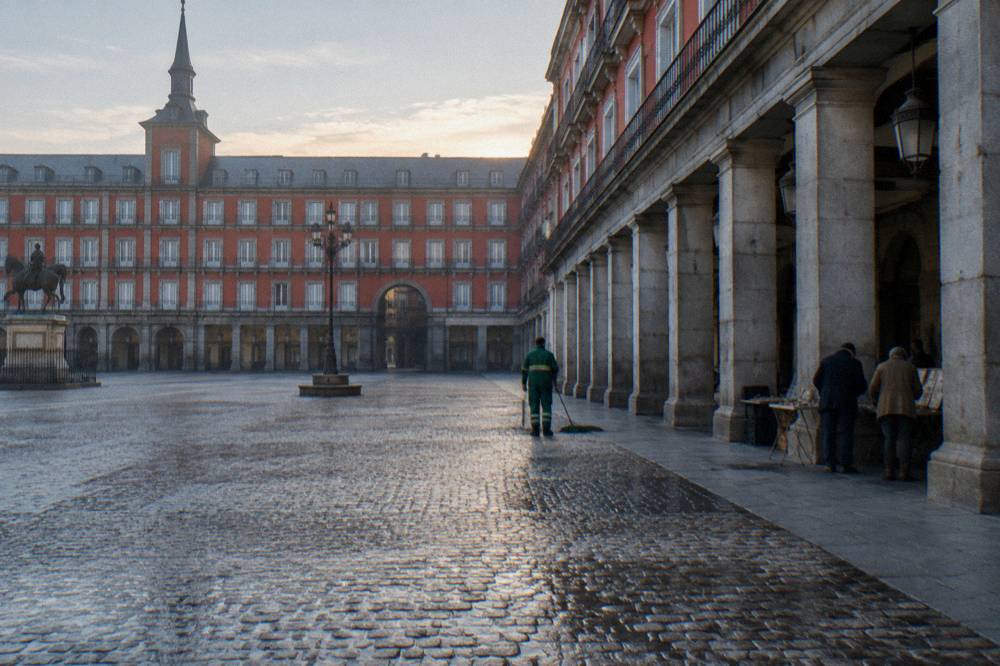
Plaza Mayor itself is worth the detour on the way, and it is free public space like everything else on this route. The square burned more than once across its history and was rebuilt after each fire, and the uniform balconied façades are deliberate city planning rather than accident. On Sundays it also fills with stamp and coin collectors at the eastern arcades, a small free sub-market most visitors walk past without noticing.
How Do You Walk The Market And La Latina's Historic Streets In One Loop?
A full loop runs Cascorro down Ribera de Curtidores to Puerta de Toledo, up through Plaza de la Cebada and the Cava Baja street, past the San Francisco el Grande church exterior, and back to Cascorro, about 3 kilometres at browsing pace. Every street and square on the loop is free public space. The only paid moments are the ones you choose, food, drinks, and market purchases.
The order matters. Do the market first, while you still have patience for crowds and the stalls are fully stocked. The market slope takes most people forty-five minutes to an hour at a genuine browse, longer if you are hunting antiques. At the bottom, Puerta de Toledo is a monumental granite gate that closes off the market slope, and it makes a natural turnaround point, with a metro stop of the same name beside it if anyone in the group is flagging.
The return leg is where La Latina shows its age, in the good sense. Cava Baja and Cava Alta follow the line of the old city wall's outer ditch, the cava, and the streets here are among the oldest surviving fabric in central Madrid. Plaza de la Cebada, the old vegetable market square, is now a lively open space with a covered market hall on one side. The church of San Francisco el Grande sits just off the loop toward the west; its exterior and the little square in front of it are free to stand in and photograph, and the dome is one of the largest in Spain.
| Walk stop | What you see | Cost |
|---|---|---|
| Plaza de Cascorro | Market monument, antiques stalls | Free |
| Ribera de Curtidores slope | Flea market stalls, side-street clusters | Free to browse |
| Puerta de Toledo | Monumental granite gate | Free |
| Plaza de la Cebada | Historic market square, covered market | Free to enter |
| Cava Baja | Old city-wall streets, tavern façades | Free |
| San Francisco el Grande exterior | Church dome and square | Free to stand outside |
One honest note on the church: the exterior and square are free, but entering San Francisco el Grande is not the same category as the free municipal churches on this site's roster. Catedral de la Almudena, further north by the Royal Palace, is the one that is genuinely free inside, nave and crypt both, with only an optional one-euro donation for the crypt, and the cathedral's own page confirms the standard daily hours. If free interiors matter to you, save that for the Almudena and treat San Francisco el Grande as an exterior stop.
If you want the market's food culture explained rather than just eaten, the Tapas And Markets Walk is a GuruWalk listing that runs two hours 45 minutes in English, Spanish and Italian, rated 4.75 out of 5 across 137 GuruWalk reviews, meeting under the statue of Philip III at Plaza Mayor. It is pay-what-you-want, and it covers the market-and-taverns territory this walk passes through, though food and drink on any food walk are paid extras.
Between the self-guided loop and the guided options, the deciding factor is appetite and energy rather than money, because every walk named here is pay-what-you-want. The Tapas And Markets Walk trades close to three hours for tavern knowledge and a local's ordering habits; the general old-town walks trade a similar stretch for the city's full story. If the shape of the day is market in the morning and a guide afterwards, The Original Free Tour is the one that meets closest to this route, at Plaza Mayor, a short walk up from the Cascorro end of the stalls.
How Much Does A Tapas Crawl In La Latina Really Cost?
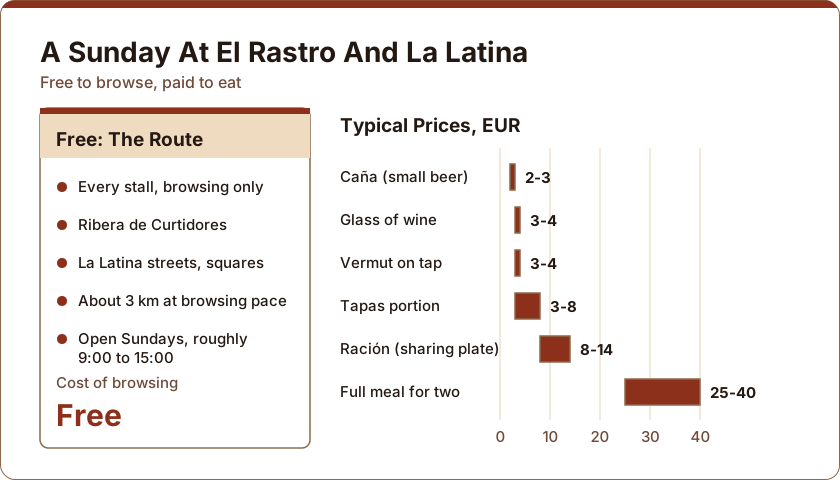
Browsing El Rastro is free, but the tapas crawl afterwards is the real cost of the day, and honest planning means treating it as a paid activity. Typical ranges: a caña of beer usually runs EUR 2-3, a glass of wine EUR 3-4, and tapas portions EUR 3-8 each depending on the tavern. Two people can eat and drink well for roughly EUR 25-40 total, or spend the whole day spending nothing at all.
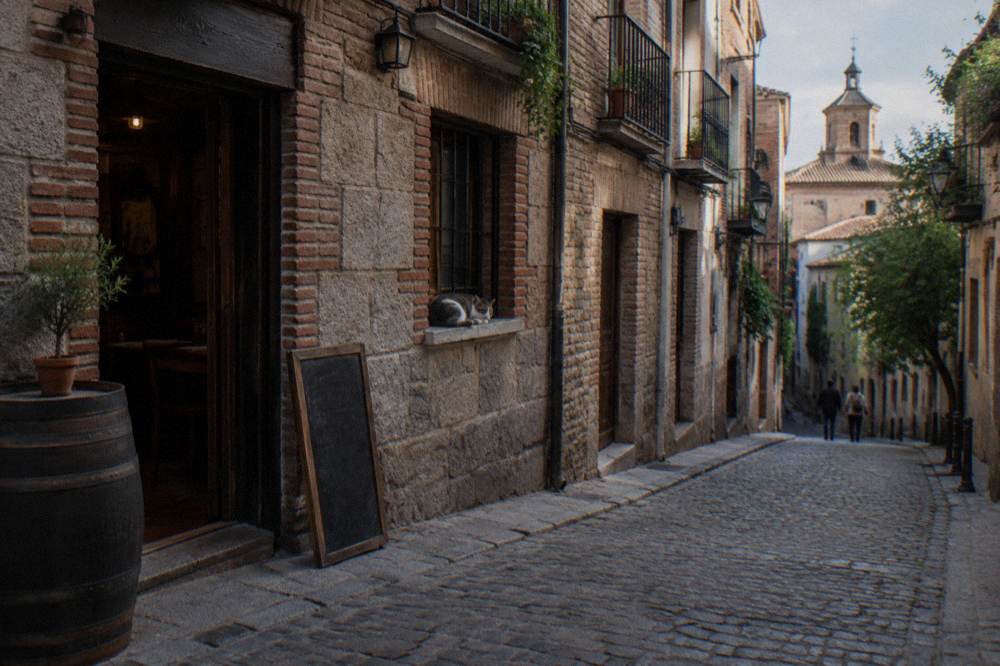
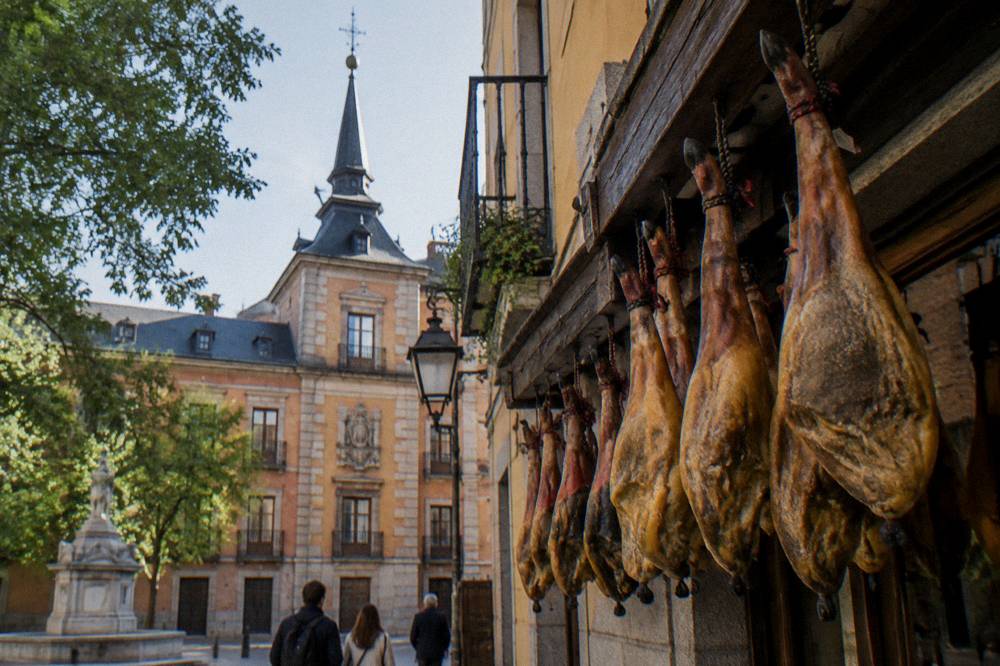
Cava Baja is the spine of the tapas crawl, wall to wall with old taverns, and on a Sunday afternoon it is the densest concentration of people eating standing up in Madrid. The honest advice is that the taverns on the street itself price for the footfall, and the streets one block either side, Calle de la Cava Alta or the lanes toward the Ronda, often serve the same food for a bit less. Check the chalkboards before you sit down, because prices move with the season and the tourist calendar. The rest of the planning pages sit on Free Things To Do In Madrid.
The classic La Latina order is the same as anywhere in Madrid: a caña, a small beer, and whatever tapas comes with it. Some taverns still run the old habit of a free small bite with each drink, but this is a courtesy, not a rule, and it varies tavern by tavern. Vermut, the house vermouth on tap, is the other local ritual, and Sunday is its natural day. Budget it like a wine, not like a beer.
| Item | Typical range | Notes |
|---|---|---|
| Caña (small beer) | EUR 2-3 | Cheapest anchor drink |
| Glass of wine | EUR 3-4 | Ask for the house pour |
| Vermut on tap | EUR 3-4 | The Sunday ritual |
| Tapas portion | EUR 3-8 | Check the chalkboard |
| Ración (sharing plate) | EUR 8-14 | Better value for two |
| Full meal for two | EUR 25-40 | Three or four stops |
Ranges, not promises: these are planning figures for the neighbourhood's taverns, and the individual tavern's board is the only authority on the day. The point of the range is that a La Latina crawl is flexible. You can do one drink and one tapa for under ten euros, or you can turn the afternoon into a four-stop lunch. What you cannot do is do it for free, and any guide that implies otherwise is selling something.
If a full budget picture is the goal, our Madrid on a budget guide breaks down the whole city, and the free things to see in Madrid guide covers the no-cost sights beyond this neighbourhood.
What Free Museums Sit On The Edge Of La Latina?
Two genuinely free museums sit within walking distance: Museo de San Isidro, which is free general admission year-round with no conditions, and Museo de Historia de Madrid, also free year-round. Museo Cerralbo is a short walk north and is free Saturday and Sunday afternoons plus Thursday evenings. The first two are municipal museums, free unconditionally, which is a different rule from the state museums' timed free windows.
The municipal-state split matters here more than anywhere in Madrid. Museo de San Isidro, on Plaza de San Andrés in the heart of La Latina, tells the story of the city's patron saint and the city's origins, and it is free every day it is open, no window, no booking, no catch. Museo de Historia de Madrid, a bit further north on Calle Fuencarral, covers the city's urban history in a grand old building and is free on the same unconditional terms. These are the two museums you can add to a Sunday walk without checking a single schedule.
Museo Cerralbo is the third option and it plays by different rules. As a state museum it has a timed free window: free Saturday afternoons from 14:00, all day Sunday, and additionally Thursday evenings from 17:00 to 20:00, plus four fixed bonus dates through the year (18 April, 18 May, 12 October and 6 December). A Sunday at El Rastro happens to be one of its free days, which makes it the easiest state museum in the city to fold into this exact walk. The palace interiors are the draw, a preserved aristocratic townhouse with its collections largely in place.
| Museum | Free rule | Distance from El Rastro |
|---|---|---|
| Museo de San Isidro | Free year-round, no conditions | In La Latina, 5 minutes |
| Museo de Historia de Madrid | Free year-round, no conditions | 20 minutes' walk north |
| Museo Cerralbo | Free Sat from 14:00, all Sun, Thu 17:00-20:00 | 15 minutes' walk north |
| Museo del Traje | Free Sat from 14:00 and Sun | Metro ride, further out |
The one museum to avoid planning around is Museo Sorolla. It has been closed since 1 October 2024, and while its new extension opens to the public on 15 October 2026, the historic house and studio stay closed for several more months. It is also far from this route, so it belongs on no version of the La Latina walk.
For the wider museum picture, including the big state museums and their evening free windows, the best free and budget museums guide covers the whole network, and the Prado free hours guide handles the city's biggest museum in detail.
When Is The Best Time To Do The Walk, And What Should You Skip?
Arrive before 11:00 to beat the worst of the crowd, do the market slope top-to-bottom first, then loop back through La Latina for tapas after 14:00 when stalls are packing up. Skip the stalls nearest the metro exits, where prices are highest and goods are most generic, and skip any Sunday that is also pouring rain, because El Rastro in the wet is miserable and half the stalls stay home.
The timing logic is straightforward. Before eleven, the market is fully stocked but not yet at crush density, and you can actually see what is on the tables. Around noon to two, the slope is at its tightest, and moving through it becomes a shuffle. After two, the stallholders start breaking down, and the haggling gets serious because nobody wants to carry stock home. Each window suits a different visitor: photographers want early, bargain hunters want late.
What to skip is just as useful. The stalls directly at the top near Cascorro metro exit are the most generic, printed goods and new-import trinkets, and the genuinely interesting clusters sit in the side streets and further down the slope. The side street with old books and posters, and the one with tools and oddities, are where the market still feels like a flea market rather than a souvenir run. Give the slope a full hour before you conclude you have seen it.
One seasonal note worth having: October visitors can catch Madrid Otra Mirada, the heritage open-days festival running 12 to 18 October 2026, which opens a record 205 normally-closed patrimonial sites across the city for free, with registration having opened on 29 September. Some of those sites sit in and around the old centre, so a mid-October Sunday walk can occasionally include a building that is closed the other fifty-one weeks of the year.
If the afternoon still has energy in it and you want the old town explained rather than just walked, the Old Town Walk, Five Languages is the GuruWalk hero of this site's roster: rated 4.92 out of 5 across 10,008 GuruWalk reviews, the largest single GuruWalk walk on the roster, running two and a quarter hours in English, Spanish, French, Italian and Portuguese from Kilometer Zero at Puerta del Sol. It is pay-what-you-want, and Puerta del Sol is a fifteen-minute walk from La Latina, so it takes the afternoon slot naturally after the market.
Can You Combine The Market With A Free Guided Walk On The Same Day?
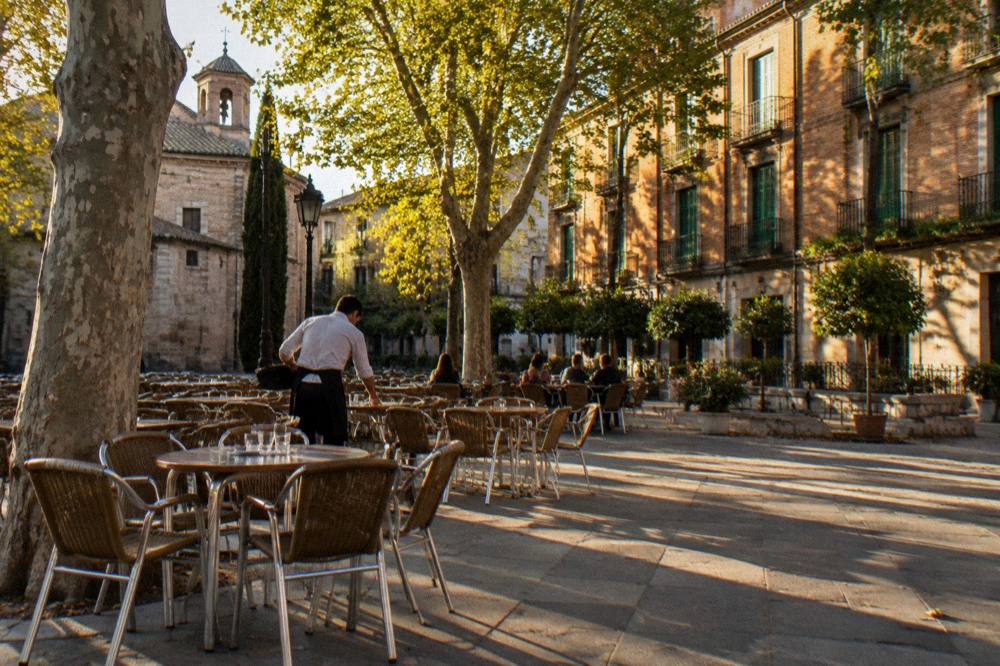
Yes, and Sunday is the easiest day to do it, because the pay-what-you-want walks run daily and the market is a morning event. The natural combination is El Rastro in the morning, tapas in La Latina at midday, then a free guided walk of the old town in the afternoon, all anchored on meeting points within fifteen minutes' walk of each other. You pay nothing for any of the walks unless you choose to tip.
The mechanics are simple. The market winds down by fifteen hundred, which leaves the whole afternoon free. The Original Free Tour, the freetour.com listing covered above, meets at Plaza Mayor and runs two and a half hours, so a 16:00 or 17:00 departure slots after a late tapas lunch. The GuruWalk alternatives meet at Puerta del Sol or Plaza Mayor, both walkable from the Cava Baja taverns, and most run in English and Spanish daily, so the day composes itself without any transit.
The budget for the combined day is then almost entirely food. The walk costs whatever you decide to tip the guide, a question this site covers separately in the how much to tip a free walking tour post, and the market costs only what you buy. For readers who want the background on the pay-what-you-want model itself, the is GuruWalk legit explainer covers how GuruWalk and its guides actually make money.
One final planning note. El Rastro is a morning event and the state museums' free windows are mostly evening events, so a Sunday can stack all three: market in the morning, La Latina and tapas at midday, a free walk in the afternoon. Cerralbo's all-day Sunday free entry is the exception that fits the morning, which is why it is the one state museum named in this guide's route. Everything else on this walk, the squares, the streets, the gate, the church exteriors, costs nothing at any hour, which is the whole point of doing Madrid this way. Free Things To Do In Madrid exists because the city genuinely works as a free destination, and this walk is its best single morning.
Common Questions About El Rastro And La Latina
Is El Rastro free to visit?
Yes, completely. The market is open public street, browsing every stall costs nothing, and there is no gate or ticket anywhere. The only money you can spend is on things you choose to buy or eat. Our is El Rastro free post covers the details.
What days is El Rastro open?
Every Sunday, plus most public holidays. Stalls set up from around 9:00 and pack up by mid-afternoon, roughly 15:00. There is no market on other days of the week.
Where does El Rastro start?
The traditional top end is Plaza de Cascorro, where stall density is highest, and the stalls run downhill along Calle de la Ribera de Curtidores toward Puerta de Toledo. Metro La Latina (Line 5) drops you right at the Cascorro end, which is why most walks of the market start there and work down the slope.
How long does the walk take?
The market slope takes about an hour at browsing pace, and the full loop with La Latina's squares runs about 3 kilometres, so two to three hours total before any tapas stops. Add an afternoon free guided walk if you want the old town explained as well.
Is the tapas crawl in La Latina free?
No, and no honest guide will tell you otherwise. Browsing the streets and squares is free, but food and drink are paid: plan roughly EUR 2-3 for a small beer and EUR 3-8 per tapas portion, and check each tavern's board on the day.
Are there free museums near La Latina?
Yes. Museo de San Isidro is in the neighbourhood and free year-round with no conditions, and Museo de Historia de Madrid is also free year-round. Museo Cerralbo, a short walk north, is free all day Sunday, which makes it the easiest state museum to add to a market day.